S3 Standard
S3 Standard is the default storage class. When no storage class is specified during file upload, S3 Standard is applied. Objects are automatically replicated across at least three Availability Zones, ensuring resilience against up to two simultaneous AZ failures and guaranteeing 11 nines (99.999999999%) of durability.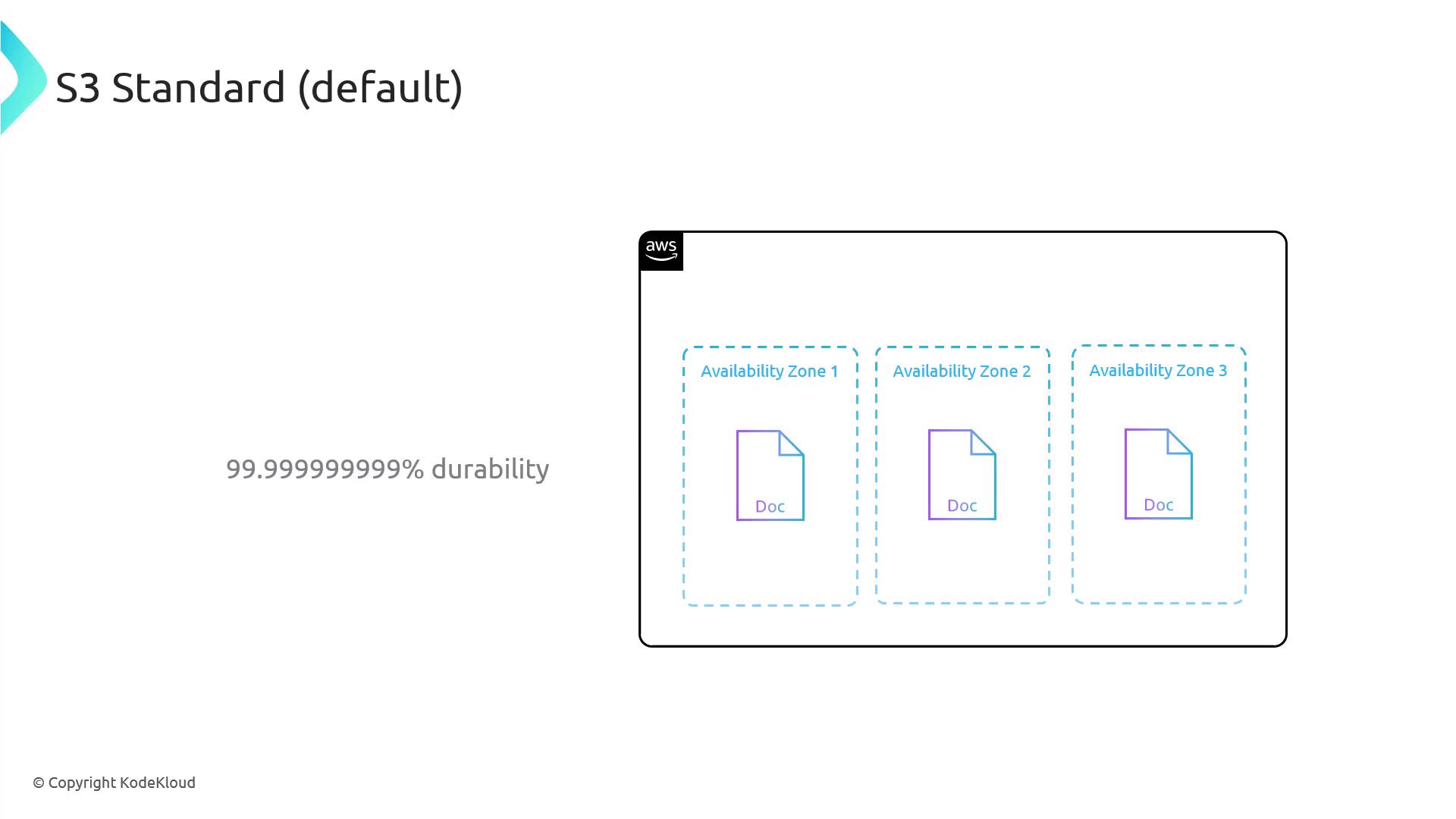
- Low latency access with millisecond response times
- Public access support for web applications when required
- No retrieval fee, minimum object size, or minimum storage duration, though data egress is charged per gigabyte
When storing frequently accessed data, S3 Standard’s high availability and low latency make it an excellent choice.
S3 Standard-IA (Infrequent Access)
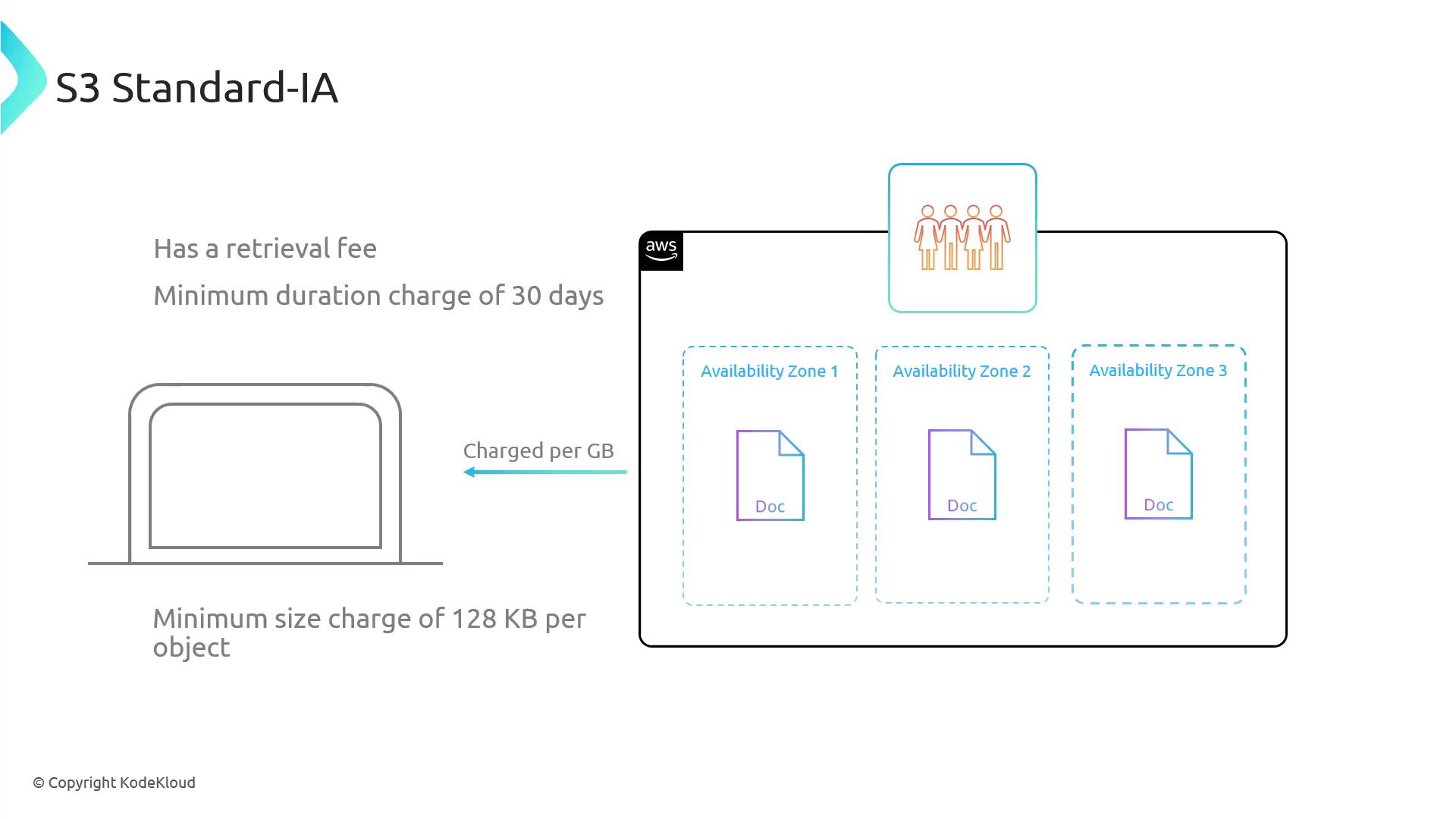
The S3 Standard-IA storage class is optimized for data that is accessed less frequently but still requires rapid access when needed. Similar to S3 Standard, it replicates objects across at least three Availability Zones with 11 nines of durability. However, S3 Standard-IA applies:- A per-gigabyte egress fee along with a retrieval fee each time data is accessed
- A minimum storage duration charge of 30 days
- A minimum object size charge of 128 kilobytes
S3 One Zone-IA
S3 One Zone-IA offers similar benefits to Standard-IA but without multi-AZ replication. Data is stored in a single Availability Zone, which significantly reduces storage costs. The key characteristics include:- Millisecond access latency
- Support for public file access
- Ingress is free, while data egress incurs charges along with a retrieval fee
- A 30-day minimum storage duration and a minimum object size charge of 128 kilobytes
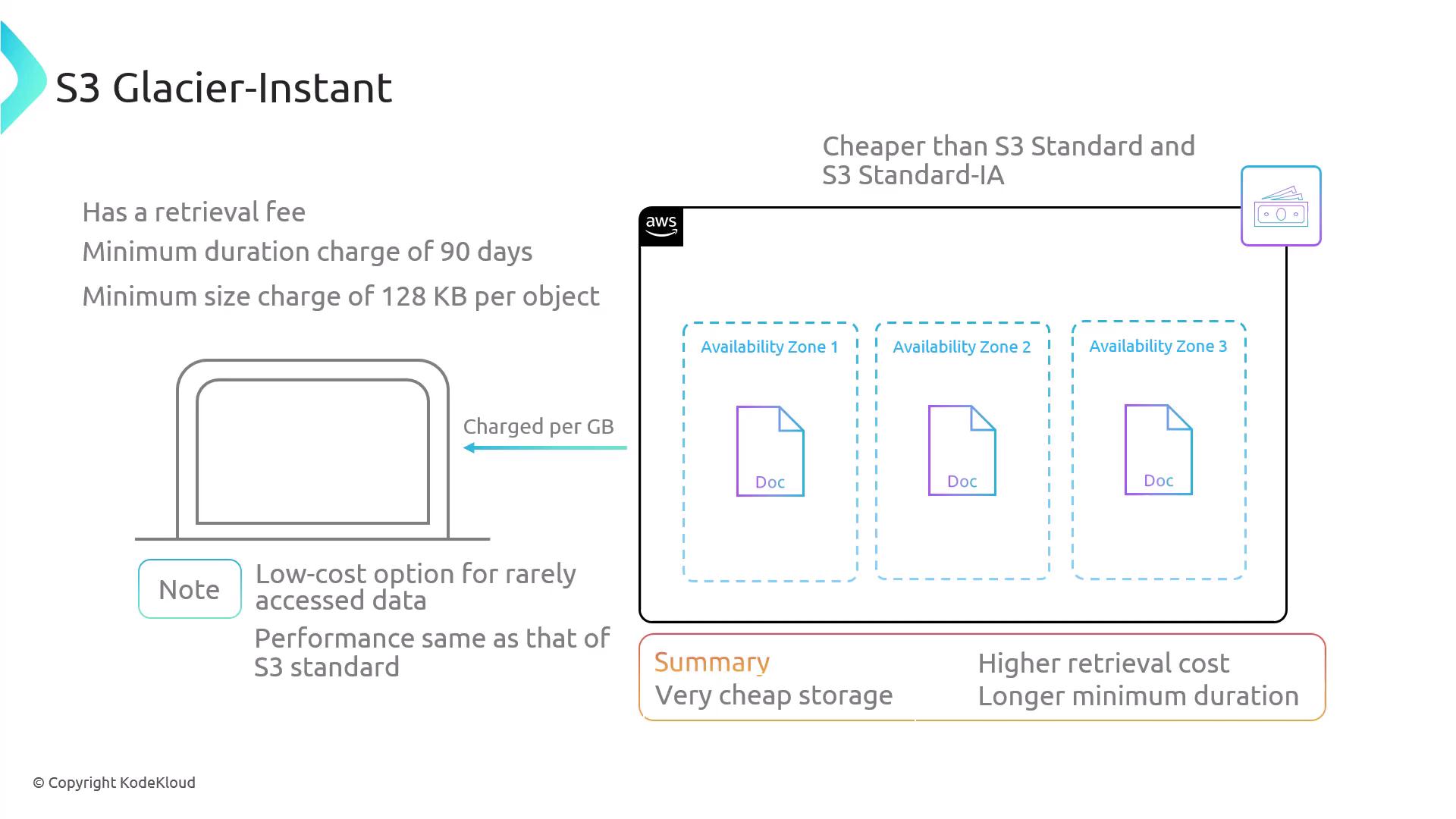
S3 Glacier Instant
Designed for archival data, S3 Glacier Instant provides low-cost storage while allowing near-instant data retrieval (within milliseconds). It offers multi-AZ replication and 11 nines of durability. Key factors include:- Free ingress with a per-gigabyte egress fee and additional retrieval fee
- A 90-day minimum storage duration and a minimum object size charge of 128 kilobytes
S3 Glacier Flexible
S3 Glacier Flexible is intended for archival data that does not require instant access. When retrieving data from Glacier Flexible, there is a delay, similar to a cold start process; hence, objects cannot be publicly accessible. Pricing details include:- Lower storage costs per gigabyte per month compared to S3 Standard options
- A per-gigabyte egress fee and additional retrieval fee
- A 90-day minimum storage duration and a minimum object size charge of 40 kilobytes
- Expedited: 1 to 5 minutes
- Standard: 3 to 5 hours
- Bulk: 5 to 12 hours
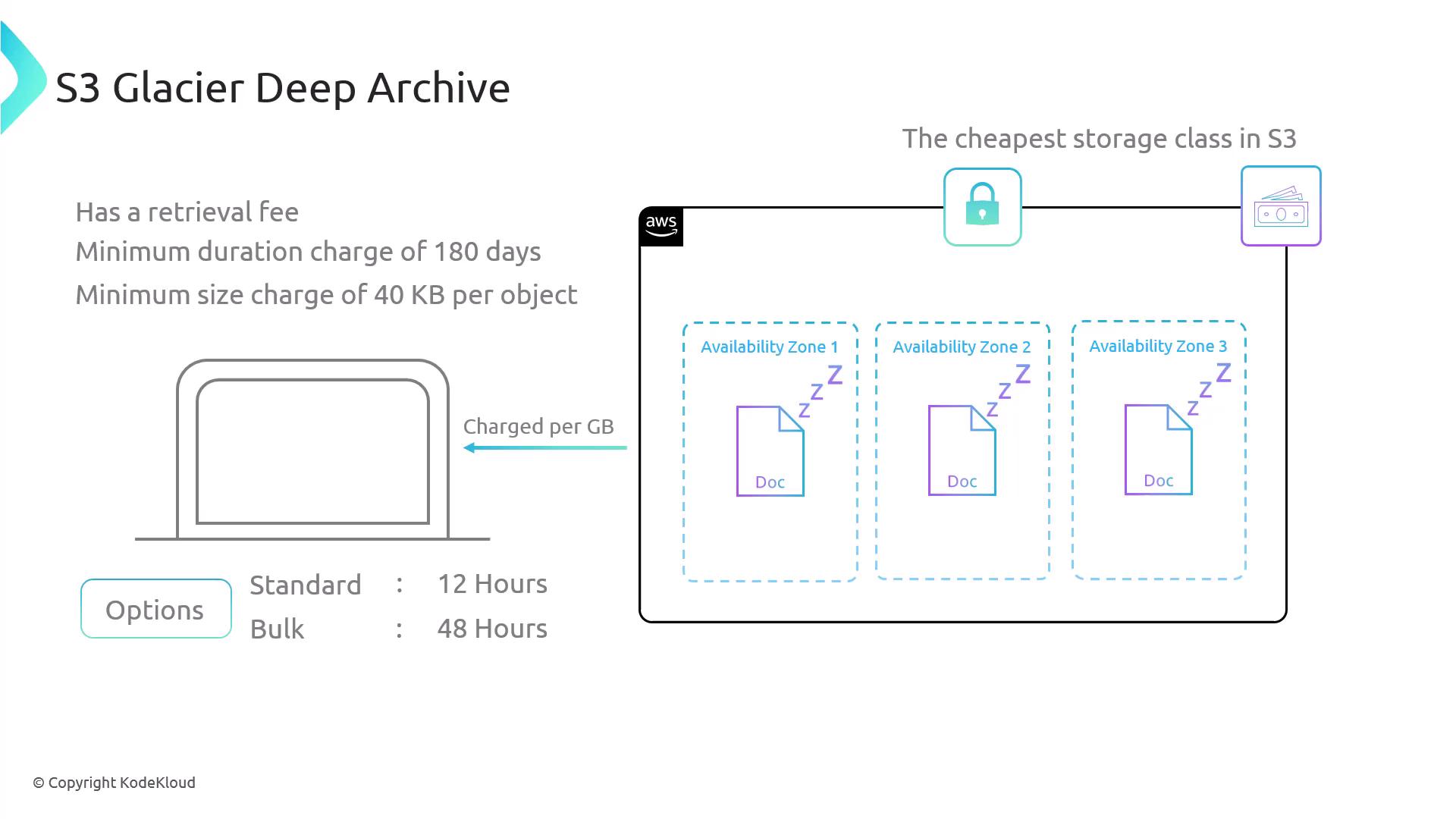
S3 Glacier Deep Archive
S3 Glacier Deep Archive is the most economical choice for data that is rarely accessed. Like Glacier Flexible, data retrieval is not immediate and objects cannot be made publicly accessible. Notable characteristics include:- The lowest per-gigabyte per month storage cost
- Additional data egress and retrieval fees
- A 180-day minimum storage duration and a minimum object size charge of 40 kilobytes
- Standard retrieval (up to 12 hours)
- Bulk retrieval (up to 48 hours)
If your archival data does not require quick access, S3 Glacier Deep Archive provides unmatched cost savings for long-term storage.
S3 Intelligent-Tiering
S3 Intelligent-Tiering simplifies storage management by automatically moving data between access tiers based on usage patterns. This ensures you only pay for the most cost-effective storage option without any retrieval delays. Be aware that in addition to the storage costs for the final tier, an extra monitoring and automation fee per 1,000 objects applies.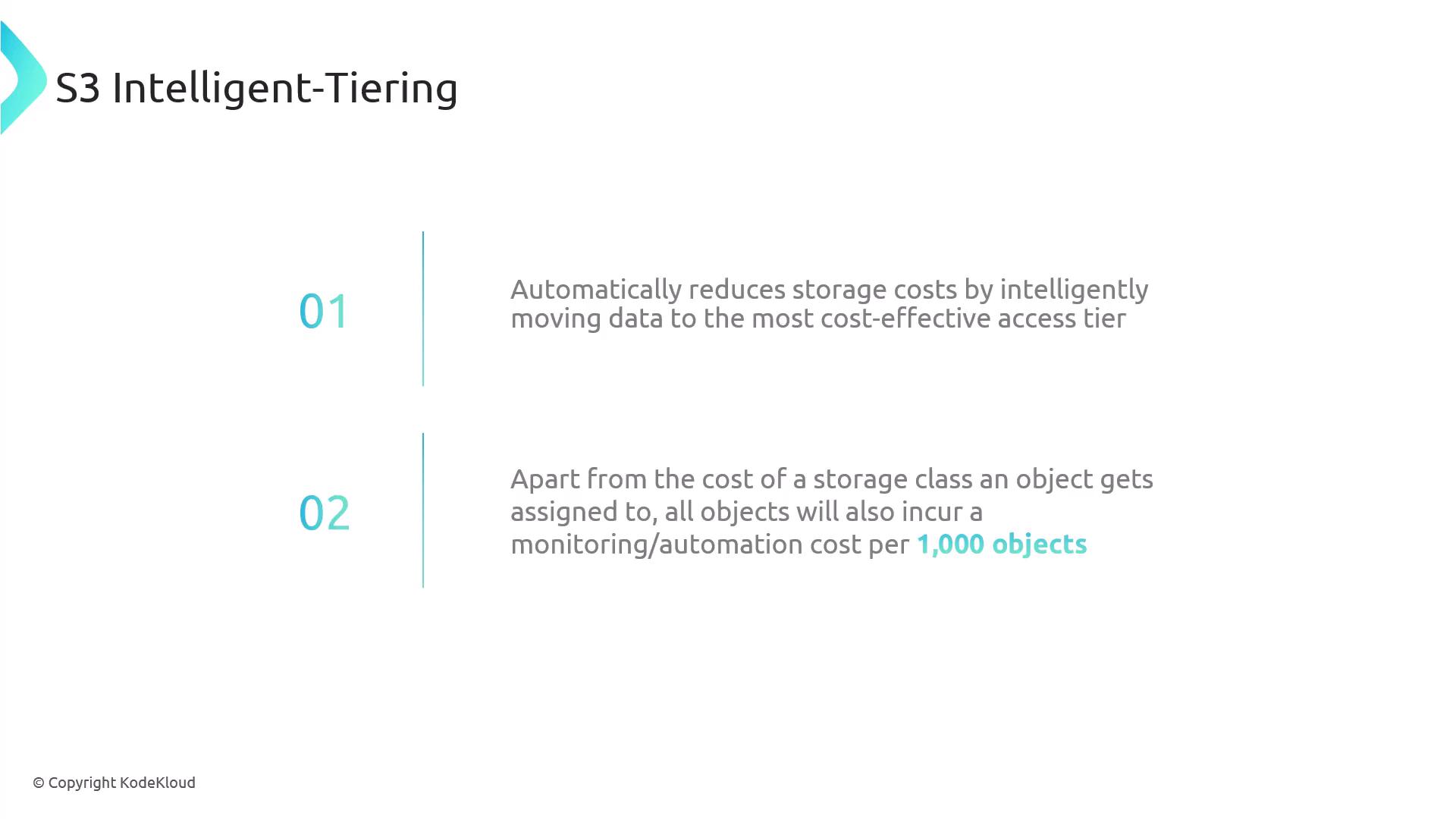
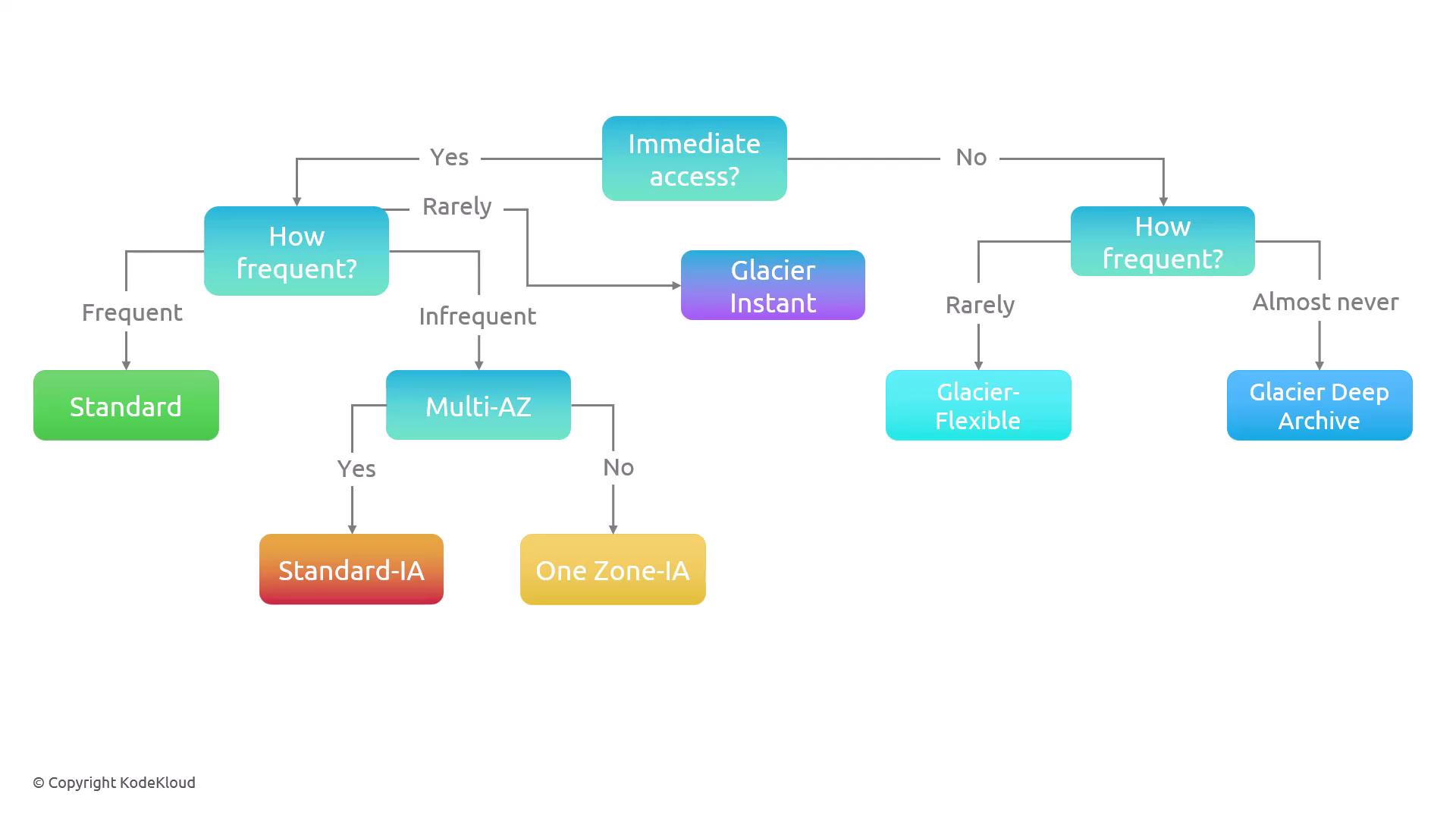
Choosing the Right Storage Class
Selecting the appropriate S3 storage class depends on your data access patterns and resiliency requirements. Consider the following guidelines:| Requirement | Recommended Storage Classes |
|---|---|
| Immediate access (within milliseconds) | S3 Standard, S3 Standard-IA, or S3 One Zone-IA |
| Archive with immediate retrieval capability | S3 Glacier Instant |
| Archival data with delayed retrieval (up to 12 hours or more) | S3 Glacier Flexible or S3 Glacier Deep Archive |
Summary
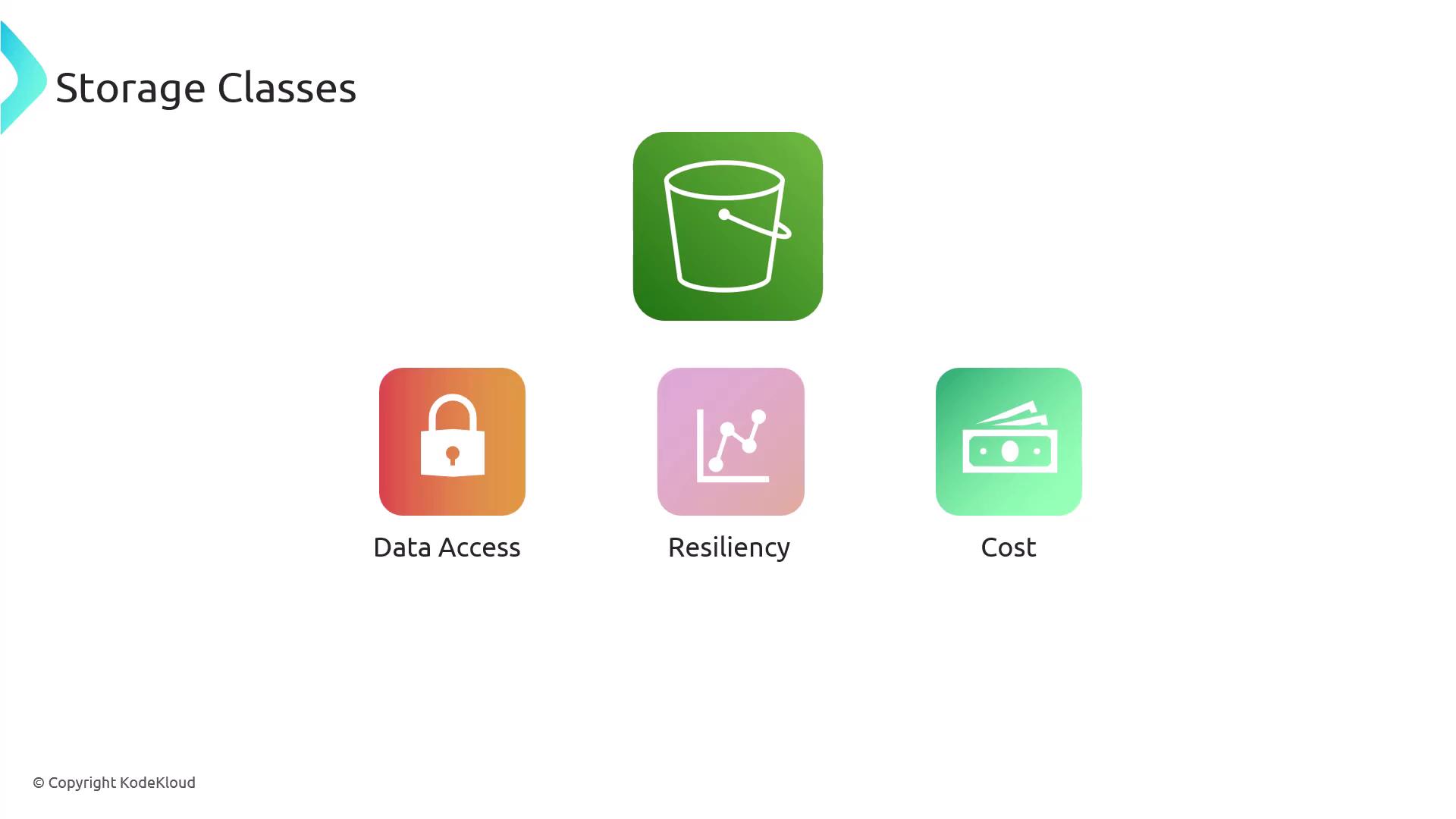
AWS S3 storage classes offer a variety of options tailored to diverse data access patterns, resiliency needs, and cost constraints. Choosing the right storage class can significantly optimize costs while meeting your specific performance requirements. To set a specific storage class for an object, include the x-amz-storage-class request header when uploading to S3.