

API Development Lifecycle
The API development process typically involves three main stages:-
Development Stage
During development, you configure endpoints, integrate external services, deploy and test the API, perform performance tests, and debug internally. Any issues identified in this stage are promptly addressed by updating the API. -
Staging (QA) Environment
Once the API functions as expected in development, it is deployed to a staging or QA environment. This stage provides a setting for iterative testing and feedback collection.
This environment acts as a final checkpoint to verify that changes on the API do not disrupt existing functionalities before moving to production.
- Production Environment
In production, the API is fully optimized for end users. Specific configurations such as increased rates, enhanced scaling, strict limits, and optimized caching are implemented. Additionally, production includes robust monitoring systems to promptly detect and resolve any operational issues.
API Gateway and Stage Variables
API Gateway simplifies the management of multiple API versions by mapping each environment to a unique stage. For instance, a production stage (e.g.,/prod) maps to one Lambda function, while a development stage (/dev) is kept separate to ensure that ongoing tests do not affect live users.
Since each environment might require distinct settings, API Gateway introduces stage variables. These variables allow dynamic, environment-specific configuration without inadvertently affecting other stages. For example, a stage variable in production might direct traffic to a particular Lambda alias, whereas the staging environment could point to a different alias of the same function.
The diagram below illustrates the API lifecycle, highlighting key tasks and processes at each stage:

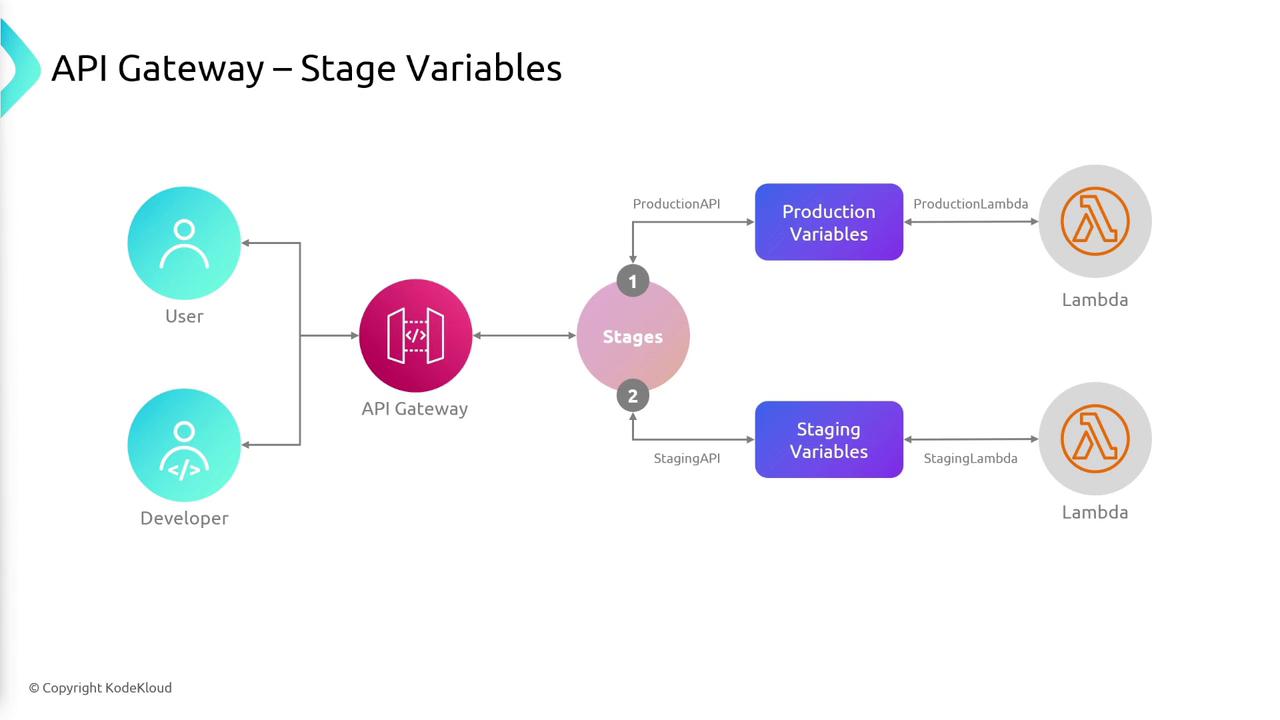
The use of stage variables is critical for maintaining distinct environment configurations under a unified API Gateway. This approach minimizes risks by isolating production from potentially disruptive changes in development or staging.