

Understanding Subnet Types
When designing your network, a straightforward question can help decide the subnet type: Should devices on the internet be able to interact with the resources in this subnet? If the answer is yes, the subnet should be public. Otherwise, it should be private. Key Points:-
Public Subnets:
Enable direct communication between the internet and your resources. Any service that needs to be accessed by users externally (e.g., a web server) should be deployed here. -
Private Subnets:
Keep your resources shielded from direct internet access. This is ideal for components that manage sensitive data or services not meant for direct user interaction, such as databases.
Practical Scenarios
Web Server and Database Architecture
Consider a web application consisting of a public-facing web server and a sensitive backend database. The web server is placed in a public subnet to handle incoming user requests, while the database resides in a private subnet to safeguard its sensitive information. The diagram below demonstrates a network architecture where a web server on a public subnet securely communicates with a database on a private subnet: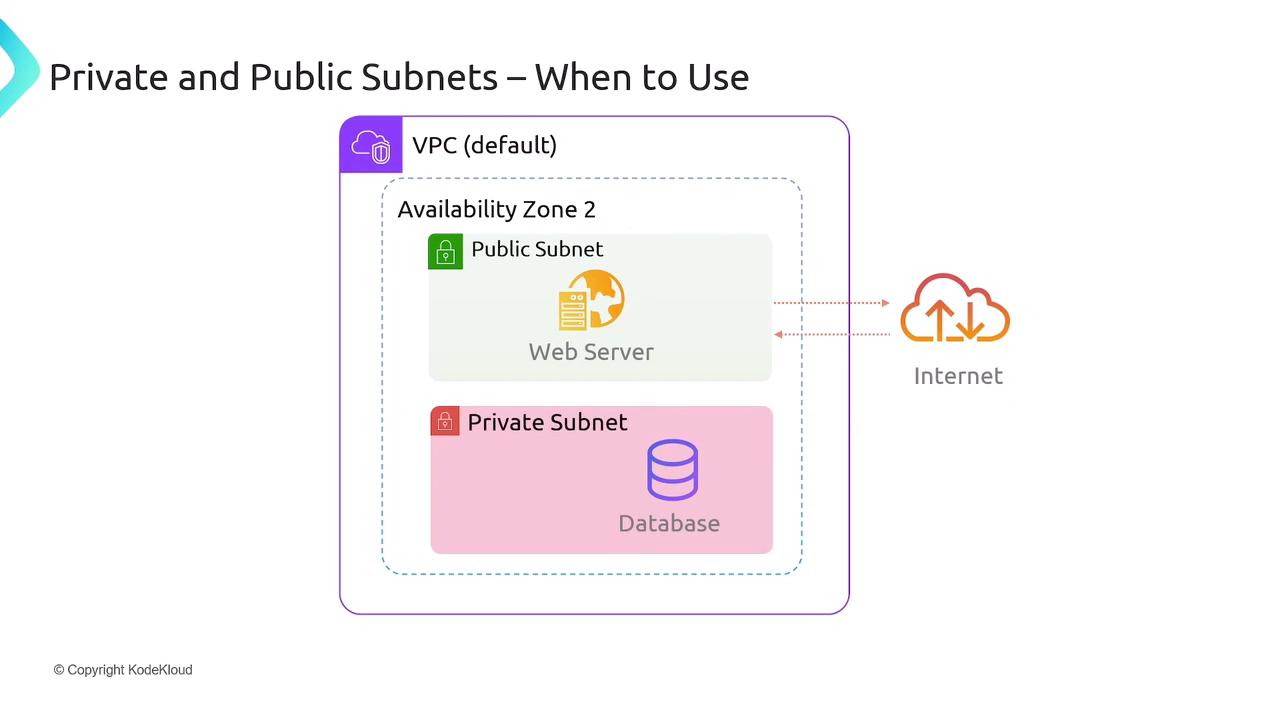
When designing multi-tier applications, isolate public-facing services from back-end databases using public and private subnets to enhance security.
Extending a Private Data Center to the Cloud
In another scenario, when extending your on-premises data center to AWS, you might deploy AWS resources in a private subnet. This configuration works well with a VPN connection between your private data center and the AWS environment, eliminating the need for public subnets. The diagram below illustrates a use case where an on-premises private data center connects via a VPN to resources residing in an AWS private subnet: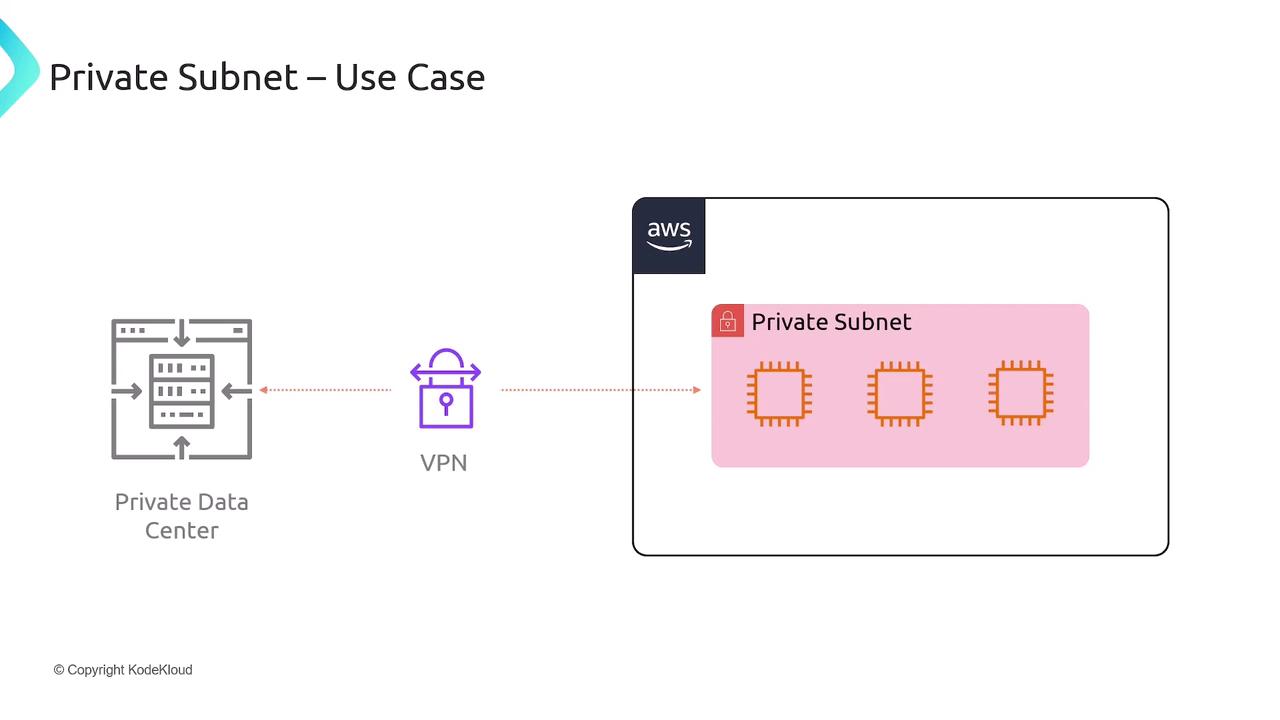
Avoid exposing sensitive services directly to the internet. Ensure that critical components such as databases remain in private subnets to reduce the risk of unauthorized access.
Summary
-
Public Subnets:
Designed for resources that require direct internet access, such as web servers. -
Private Subnets:
Suitable for resources that should remain inaccessible from the internet, like databases and internal services.