

What is Amazon Neptune?
Amazon Neptune is a fully managed graph database service designed specifically for the cloud. It simplifies building and running graph applications by handling infrastructure management, ensuring built-in security, continuous backups, and serverless operations. With Neptune, developers can focus on building applications without the overhead of maintaining the underlying infrastructure. Additionally, Neptune integrates seamlessly with numerous AWS services. Neptune is engineered for global distribution. A single Neptune database can operate across multiple AWS regions, replicating data with minimal performance impact. The Neptune global database feature allows you to deploy a primary database in one AWS region while replicating data to up to five secondary read-only clusters in different regions.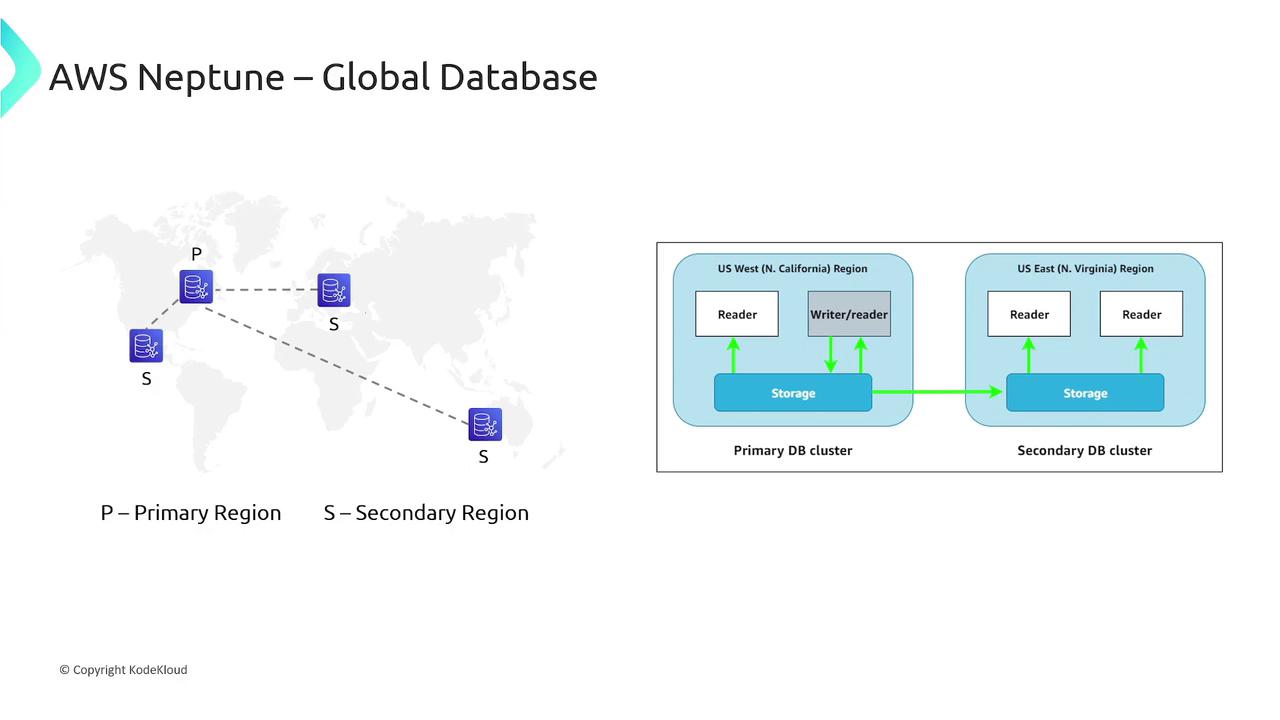
Key Features of AWS Neptune
-
Serverless Operation:
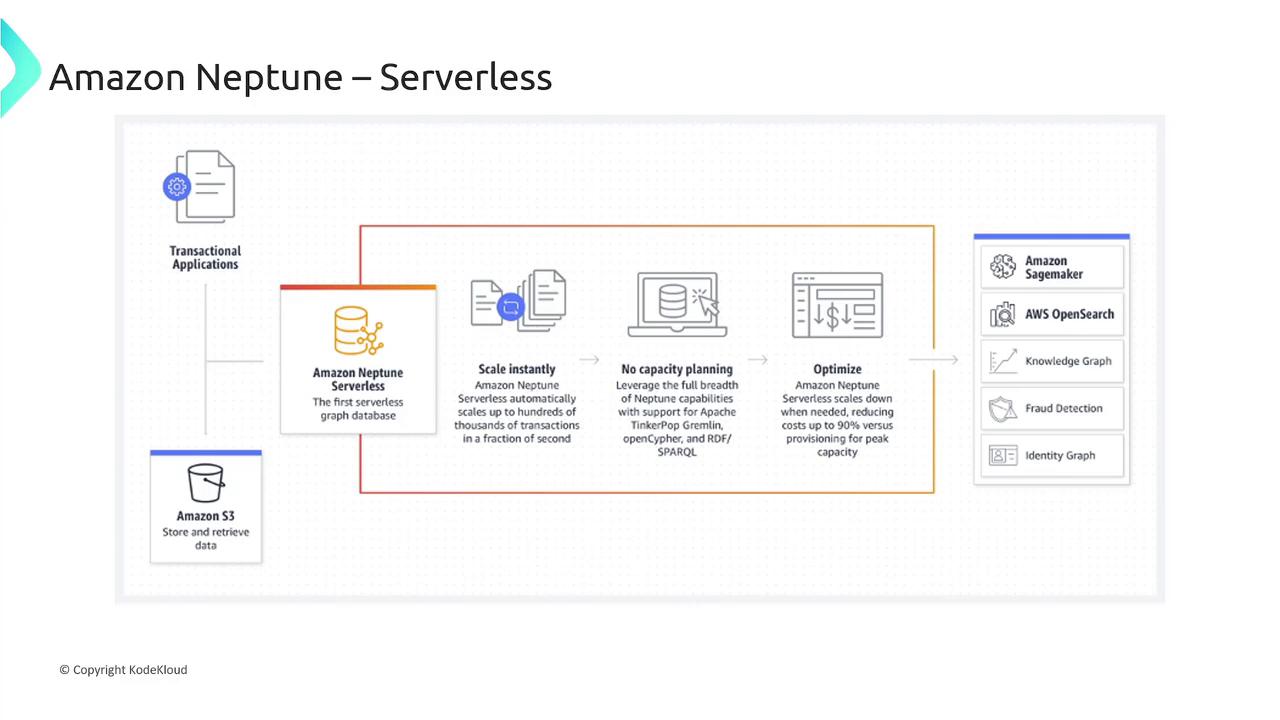
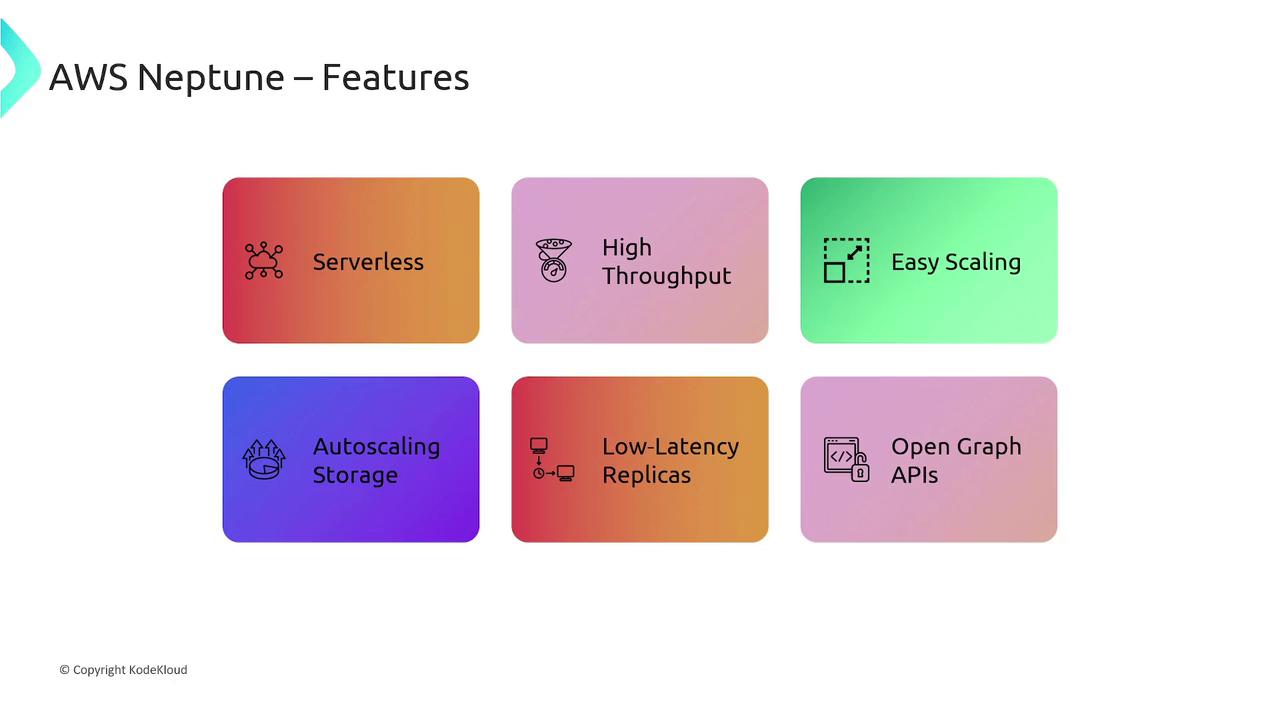
Neptune Serverless is an on-demand deployment model that automatically adjusts capacity based on your application’s needs. It guarantees high throughput and low latency for graph queries. With a few clicks in the AWS Management Console, you can scale compute and memory resources for your production clusters. Storage scales accordingly, and the service delivers access to low latency read replicas. Additionally, it supports open graph APIs including Apache TinkerPop and Gremlin. -
Integration with AWS Services:
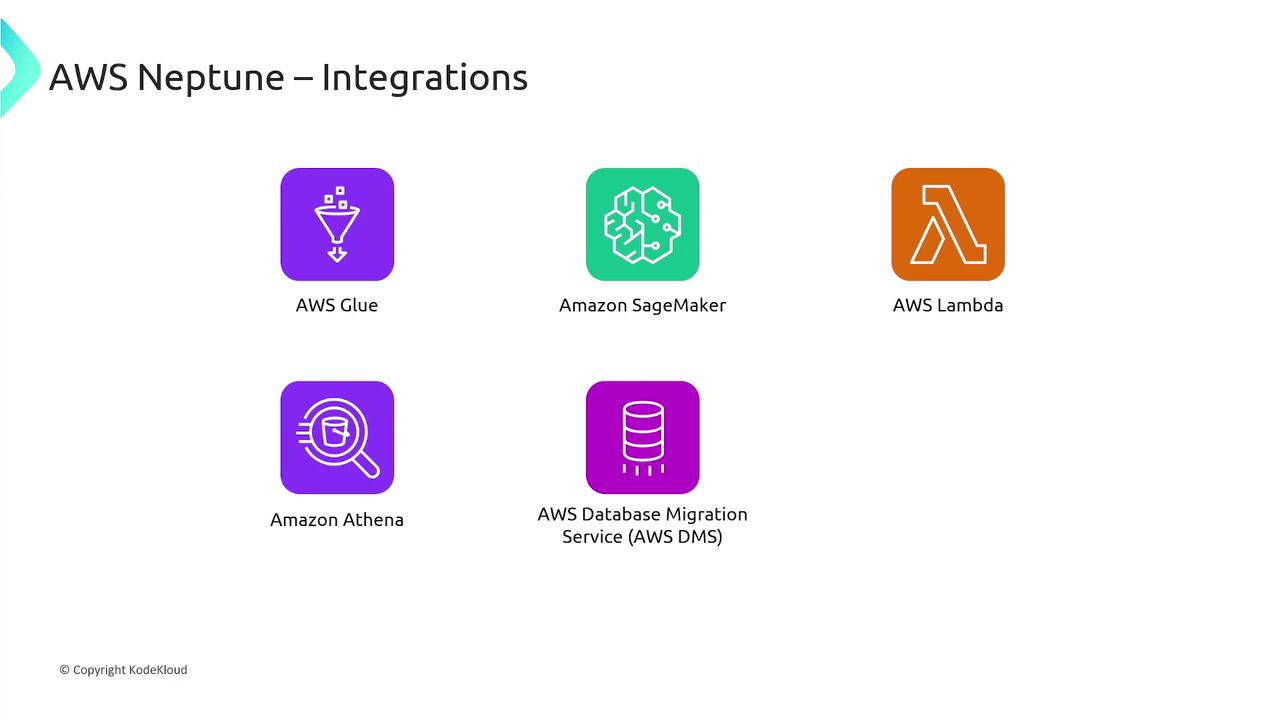
AWS Neptune easily integrates with various AWS services such as AWS Glue, SageMaker, Lambda, Amazon Athena, AWS Database Migration Service (DMS), and AWS Backup. This broad integration ecosystem enhances its utility for diverse application scenarios.
- Diverse Use Cases:
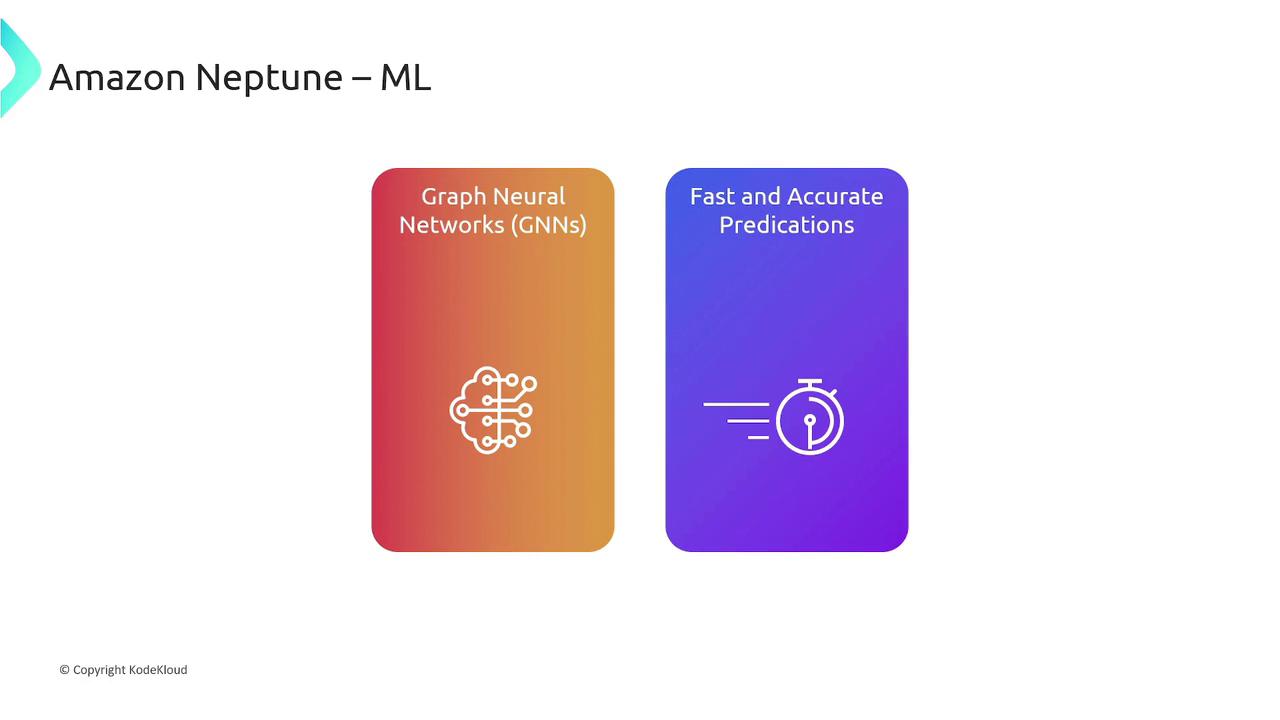
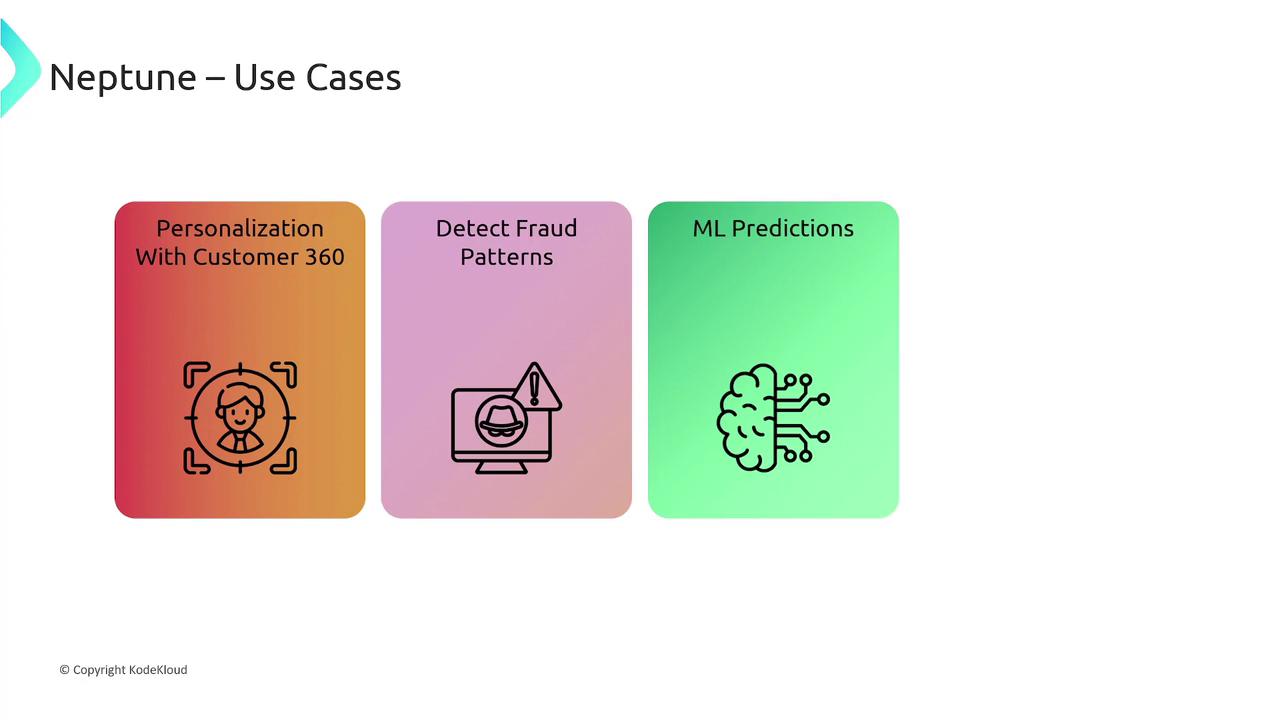
Neptune is commonly used for constructing identity graphs that provide a 360-degree view of customers, enabling targeted advertising, personalization, and comprehensive analytics. It is also effective in detecting fraud patterns. Furthermore, Neptune ML harnesses graph neural networks to enhance prediction accuracy and can detect and investigate IT infrastructure issues using layered security approaches.
Remember, designing graph databases enables your applications to naturally model real-world connections, offering a significant advantage over traditional databases when dealing with complex relationships.
Summary of Neptune
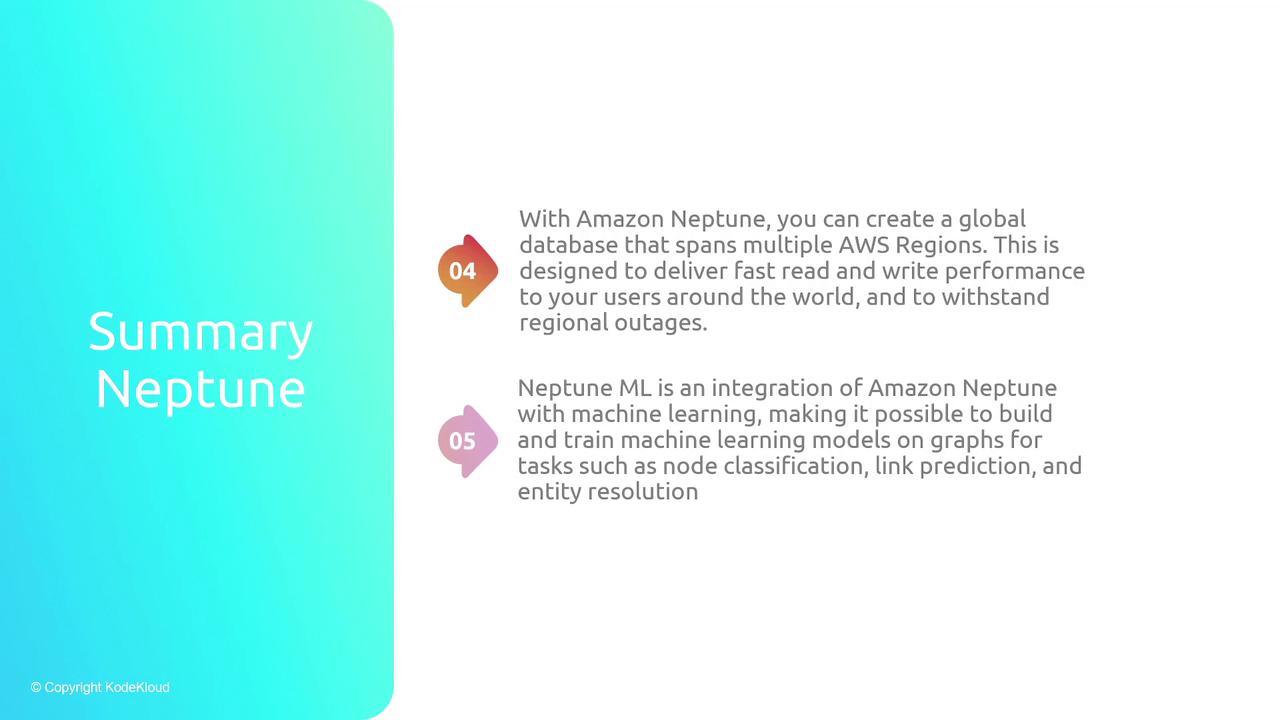
Amazon Neptune is a fast, reliable, and fully managed graph database service optimized for handling complex, highly connected datasets. It is built to manage billions of relationships while supporting millisecond query latencies. By offloading the operational responsibilities such as hardware provisioning, database setup, patching, and backups to AWS, Neptune allows you to concentrate on application development. Neptune supports multiple graph models, such as the Property Graph and W3C RDF, and offers powerful query languages like Apache TinkerPop, Gremlin, and SPARQL. Its capability to create global databases spanning multiple AWS regions ensures high performance and resilience against regional outages. Moreover, Neptune ML extends your analytical capabilities by integrating machine learning for advanced tasks such as node classification, link prediction, and entity resolution. This makes it an ideal solution for extracting deeper insights from interconnected data.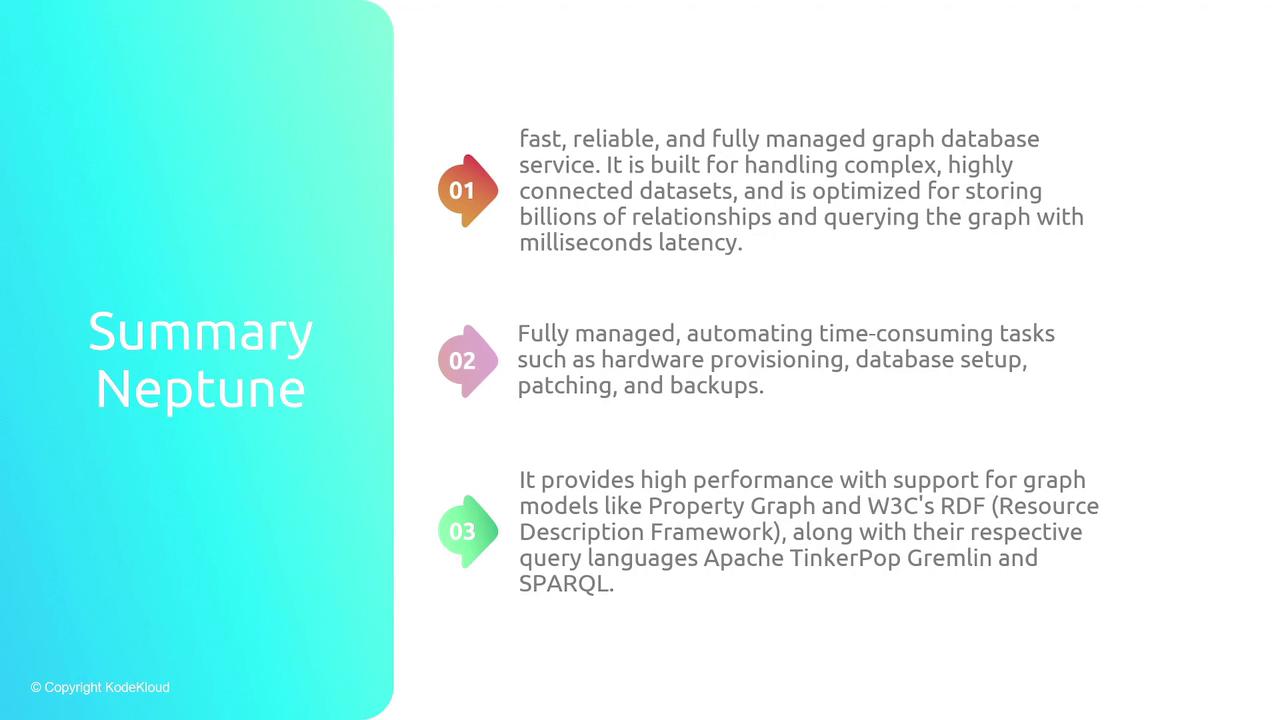
For more information on AWS Neptune, explore the AWS Neptune Documentation. You may also find the Kubernetes Basics guide useful when considering how graph databases interact with containerized environments.