In this guide, you’ll learn how to pass inputs into GitHub Actions reusable workflows to handle configuration values—such as MongoDB credentials—without relying on environment variables in the caller workflow.
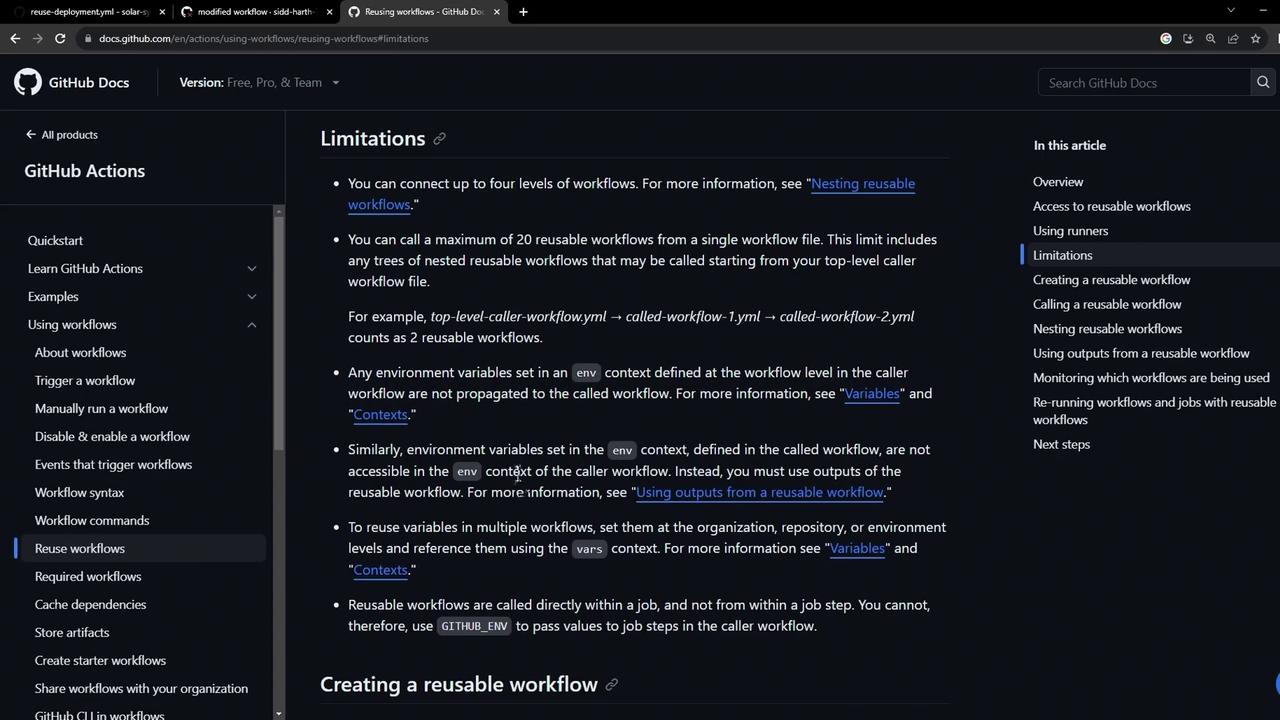
Environment variables defined in a caller workflow do not propagate into a called reusable workflow. Attempting to pass sensitive data like database URIs via env: will result in empty values.
For example, this command fails to set MONGO_URI:
kubectl -n development create secret generic mongo-db-creds \ --from-literal=MONGO_URI= \ --from-literal=MONGO_USERNAME=superuser \ --from-literal=MONGO_PASSWORD= *** \ --save-config \ --dry-run=client \ -o yaml | kubectl apply -f -
This is a documented limitation of reusable workflows .
1. Define a Basic Reusable Workflow Create a workflow—e.g. .github/workflows/reuse-deployment.yml—that declares the required secrets under workflow_call. This allows callers to supply kubeconfig and database passwords securely:
name : Deployment - Reusable Workflow on : workflow_call : secrets : k8s-kubeconfig : required : true mongodb-password : required : true jobs : reuse-deploy : environment : name : development url : https://${{ steps.set-ingress-host-address.outputs.APP_INGRESS_HOST }} outputs : APP_INGRESS_URL : ${{ steps.set-ingress-host-address.outputs.APP_INGRESS_HOST }} runs-on : ubuntu-latest steps : - name : Checkout Repo uses : actions/checkout@v4 - name : Install kubectl CLI uses : azure/setup-kubectl@v3 with : version : '1.26.0' - name : Set Kubeconfig file uses : azure/k8s-set-context@v3 with : method : kubeconfig kubeconfig : ${{ secrets.k8s-kubeconfig }} - name : Fetch Kubernetes Cluster Details run : | kubectl version --short echo "-------------------------------------------" kubectl get nodes - name : Save Nginx Ingress Controller IP as an Output id : set-ingress-host-address run : | IP=$(kubectl -n ingress-nginx get svc ingress-nginx-controller \ -o jsonpath='{.status.loadBalancer.ingress[0].ip}') echo "APP_INGRESS_HOST=$IP" >> $GITHUB_OUTPUT - name : Replace Tokens in Manifests uses : cschijden/replace-tokens@v1 with : tokenPrefix : __ tokenSuffix : __ files : [ "kubernetes/development/*.yaml" ] env : NAMESPACE : ${{ vars.NAMESPACE }} REPLICAS : ${{ vars.REPLICAS }} IMAGE : ${{ vars.DOCKERHUB_USERNAME }}/solar-system:${{ github.sha }} INGRESS_IP : ${{ steps.set-ingress-host-address.outputs.APP_INGRESS_HOST }} - name : Inspect Rendered Manifests run : cat kubernetes/development/*.yaml - name : Create MongoDB Secret run : | kubectl -n ${{ vars.NAMESPACE }} create secret generic mongo-db-creds \ --from-literal=MONGO_URI=${{ env.MONGO_URI }} \ --from-literal=MONGO_USERNAME=${{ vars.MONGO_USERNAME }} \ --from-literal=MONGO_PASSWORD=${{ secrets.mongodb-password }} \ --save-config - name : Deploy to Development Environment run : kubectl apply -f kubernetes/development
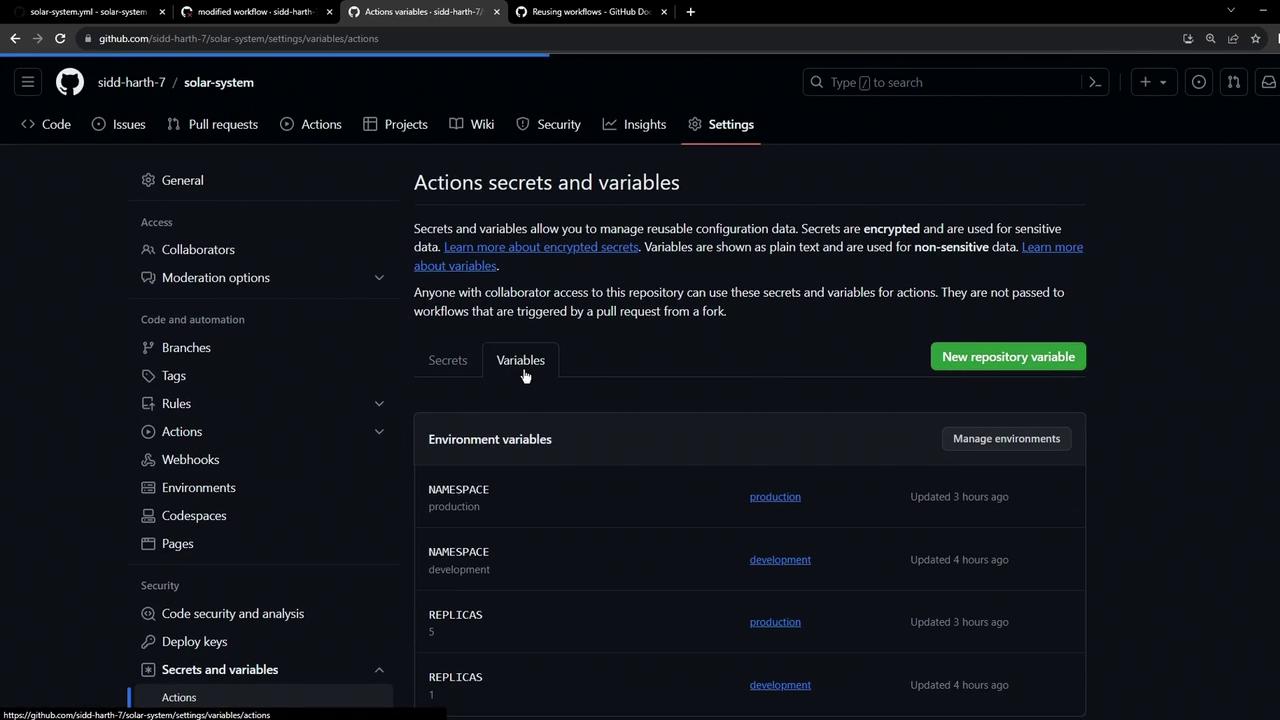
2. Store MongoDB URI as a Repository Variable Go to Settings > Actions > Secrets and variables > Variables and add:
Name : MONGO_URIValue : mongodb+srv://supercluster.d8jj.mongodb.net/superData
Now the workflow can reference env.MONGO_URI without relying on the caller’s env: block.
Enhance your reusable workflow by defining typed inputs for maximum flexibility:
name : Deployment - Reusable Workflow on : workflow_call : inputs : mongodb-uri : description : MongoDB connection string required : true type : string kubectl-version : description : kubectl CLI version required : false default : v1.26.0 type : string k8s-manifest-dir : description : Path to Kubernetes manifests required : true default : kubernetes/ type : string environment : description : Deployment environment name required : true default : dev type : string secrets : k8s-kubeconfig : required : true mongodb-password : required : true
Input Name Type Required Default Description mongodb-uristring Yes — MongoDB connection string kubectl-versionstring No v1.26.0Version of kubectl to install k8s-manifest-dirstring Yes kubernetes/Directory containing manifests environmentstring Yes devName of the target environment
Update steps to reference inputs instead of hard-coded values:
jobs : reuse-deploy : environment : name : ${{ inputs.environment }} url : https://${{ steps.set-ingress-host-address.outputs.APP_INGRESS_HOST }} runs-on : ubuntu-latest steps : # ... - name : Install kubectl CLI uses : azure/setup-kubectl@v3 with : version : ${{ inputs.kubectl-version }} # ... - name : Replace Tokens in Manifests uses : cschijden/replace-tokens@v1 with : files : [ "${{ inputs.k8s-manifest-dir }}*.yaml" ] env : INGRESS_IP : ${{ steps.set-ingress-host-address.outputs.APP_INGRESS_HOST }} # ... - name : Create MongoDB Secret run : | kubectl -n ${{ vars.NAMESPACE }} create secret generic mongo-db-creds \ --from-literal=MONGO_URI=${{ inputs.mongodb-uri }} \ --from-literal=MONGO_USERNAME=${{ vars.MONGO_USERNAME }} \ --from-literal=MONGO_PASSWORD=${{ secrets.mongodb-password }} \ --save-config \ --dry-run=client -o yaml | kubectl apply -f - # ... - name : Deploy to ${{ inputs.environment }} run : kubectl apply -f "${{ inputs.k8s-manifest-dir }}"
In your caller workflow (e.g. .github/workflows/dev-deploy.yml), pass inputs via with: and secrets as before:
dev-deploy : if : contains(github.ref, 'feature/') needs : docker uses : ./.github/workflows/reuse-deployment.yml with : mongodb-uri : ${{ vars.MONGO_URI }} kubectl-version : v1.27.0 # optional override environment : development k8s-manifest-dir : kubernetes/development/ secrets : k8s-kubeconfig : ${{ secrets.KUBECONFIG }} mongodb-password : ${{ secrets.MONGO_PASSWORD }} prod-deploy : if : github.ref == 'refs/heads/main' needs : docker uses : ./.github/workflows/reuse-deployment.yml with : mongodb-uri : ${{ vars.MONGO_URI }} environment : production k8s-manifest-dir : kubernetes/production/ secrets : k8s-kubeconfig : ${{ secrets.KUBECONFIG }} mongodb-password : ${{ secrets.MONGO_PASSWORD }}
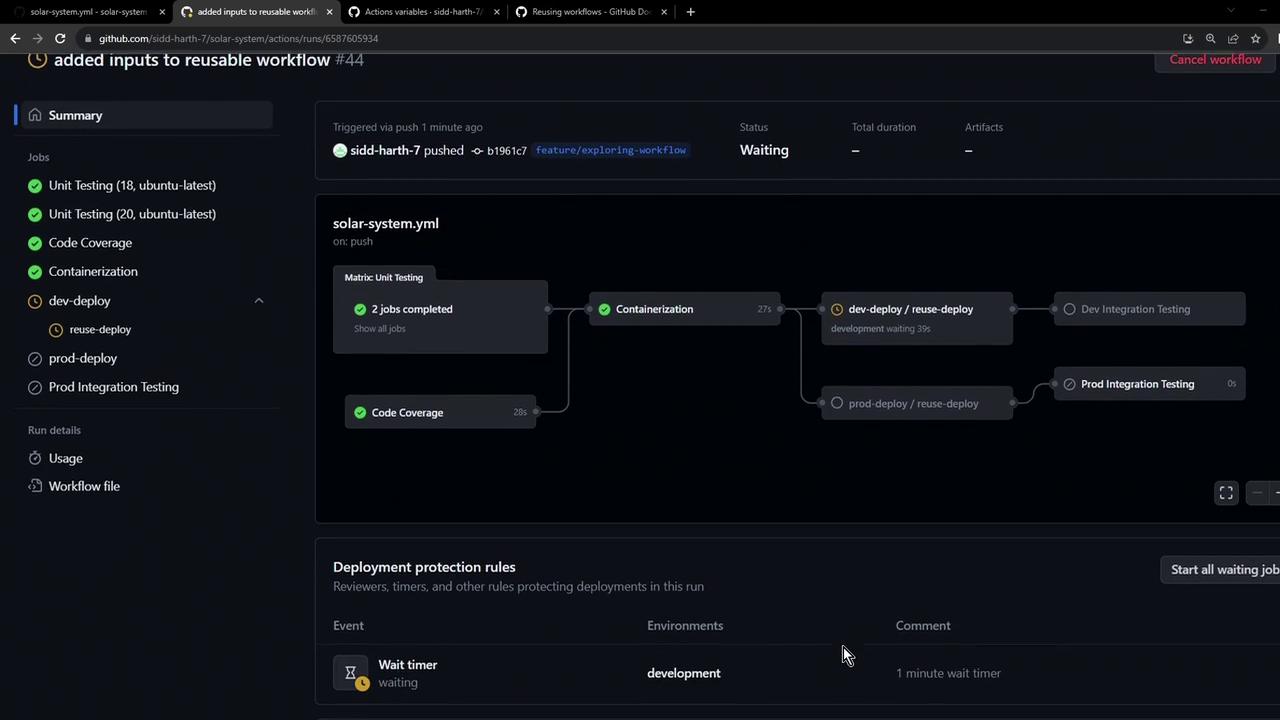
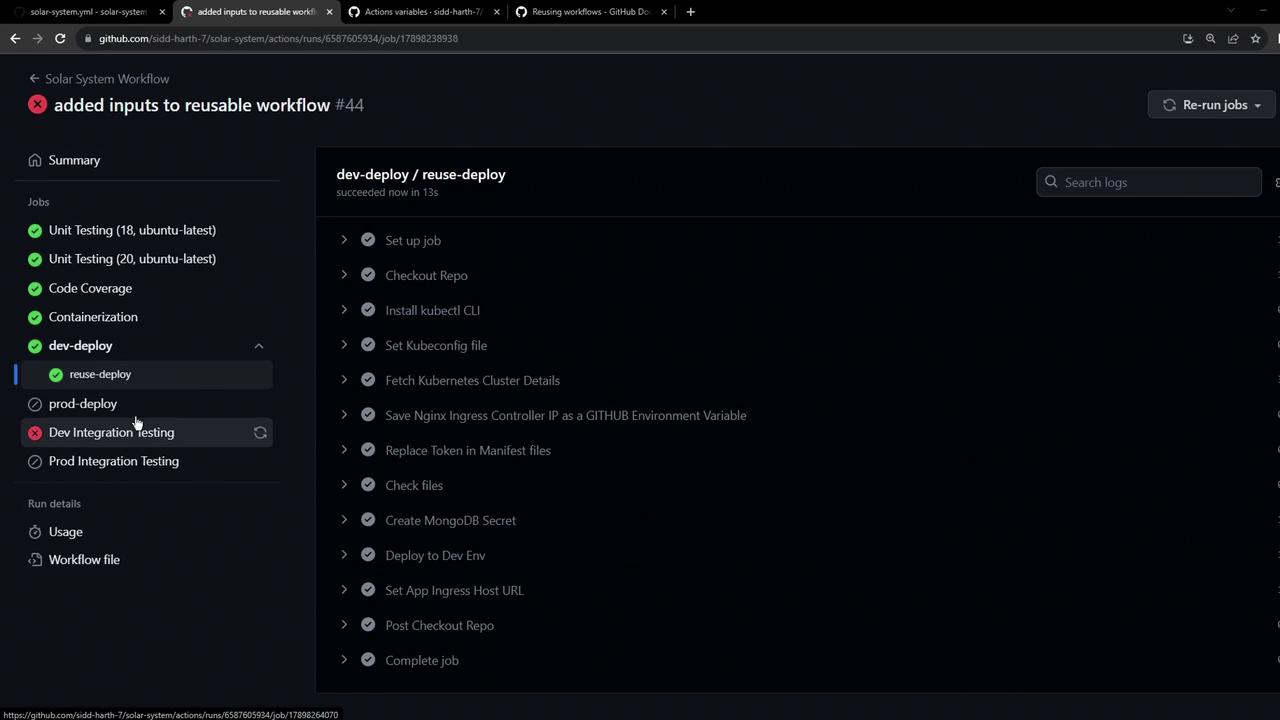
After pushing, the dev-deploy run shows the inputs and secrets correctly applied:
You’ll see:
mongodb-uri sourced from the repository variable.kubectl-version defaulting to v1.26.0 unless overridden.The manifest directory and environment matching the with: values.
The MongoDB secret creation now succeeds:
kubectl -n development create secret generic mongo-db-creds \ --from-literal=MONGO_URI=mongodb+srv://supercluster.d8jj.mongodb.net/superData \ --from-literal=MONGO_USERNAME=superuser \ --from-literal=MONGO_PASSWORD= *** \ --save-config \ --dry-run=client \ -o yaml | kubectl apply -f -
If you need outputs (like APP_INGRESS_URL) in the caller workflow, use outputs in the reusable workflow and capture them via the needs context.
Links and References