

Why Embed Software Composition Analysis?
Incorporating SCA early in your pipeline helps you:- Catch security issues before they reach production
- Reduce the cost and effort of late-stage remediation
- Enforce uniform security policies across all pull requests
Shifting security left with SCA accelerates feedback loops and safeguards your main branch from hidden vulnerabilities.
How SCA Fits into a DevSecOps Pipeline
When a developer opens a pull request:- The CI system triggers an automated build based on established policies.
- An incremental SCA scan runs against new or modified code and dependencies.
- If vulnerabilities are found, the build fails and the PR cannot merge until fixes are applied.
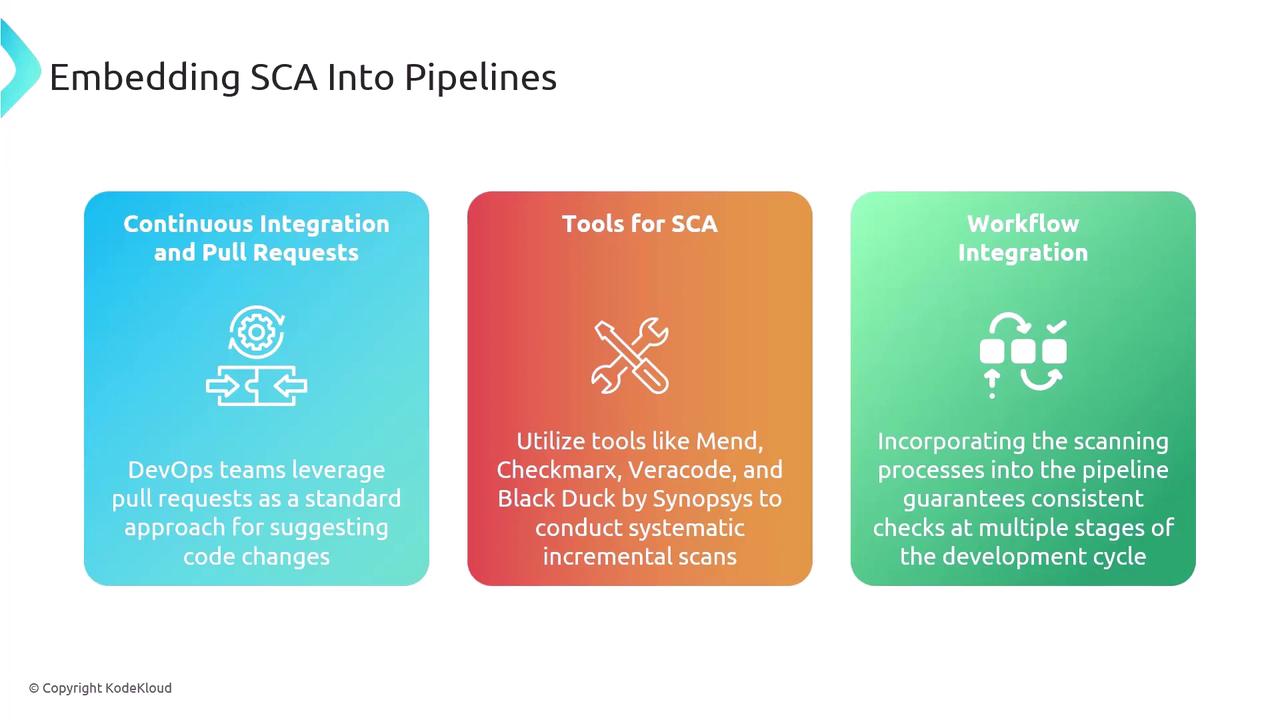
1. Continuous Integration and Pull Requests
Pull requests serve as the perfect gate for security validation. Configure your CI platform—Azure Pipelines, GitHub Actions, Jenkins, or others—to initiate SCA scans on every PR. This ensures no code merges without passing vulnerability checks.2. Tools for SCA
Compare popular SCA solutions that integrate seamlessly into your pipeline:| Tool | Key Features | Integration Examples |
|---|---|---|
| Mend | Incremental scans, policy enforcement | Azure DevOps, GitHub |
| Checkmarx | Code and open-source analysis | Jenkins, GitLab CI |
| Veracode | Cloud-based scanning, detailed reporting | Azure Pipelines, Bitbucket |
| Black Duck | Dependency hygiene, license compliance | GitHub Actions, CircleCI |
3. Workflow Integration
Automate SCA at defined stages of your build or release pipeline:- Pre-merge Checks: Block pull requests with critical findings.
- Nightly Scans: Perform full-codebase audits to catch drift.
- Release Gates: Ensure no high- or medium-risk issues remain before deployment.