This article discusses updating the post schema to include owner information and necessary adjustments for API functionality.
In this article, we review the changes introduced in the previous lesson and outline the necessary updates to our application. Due to recent modifications, certain API requests demonstrate outdated behavior. We will walk through these requests and explain the adjustments required for proper functionality.
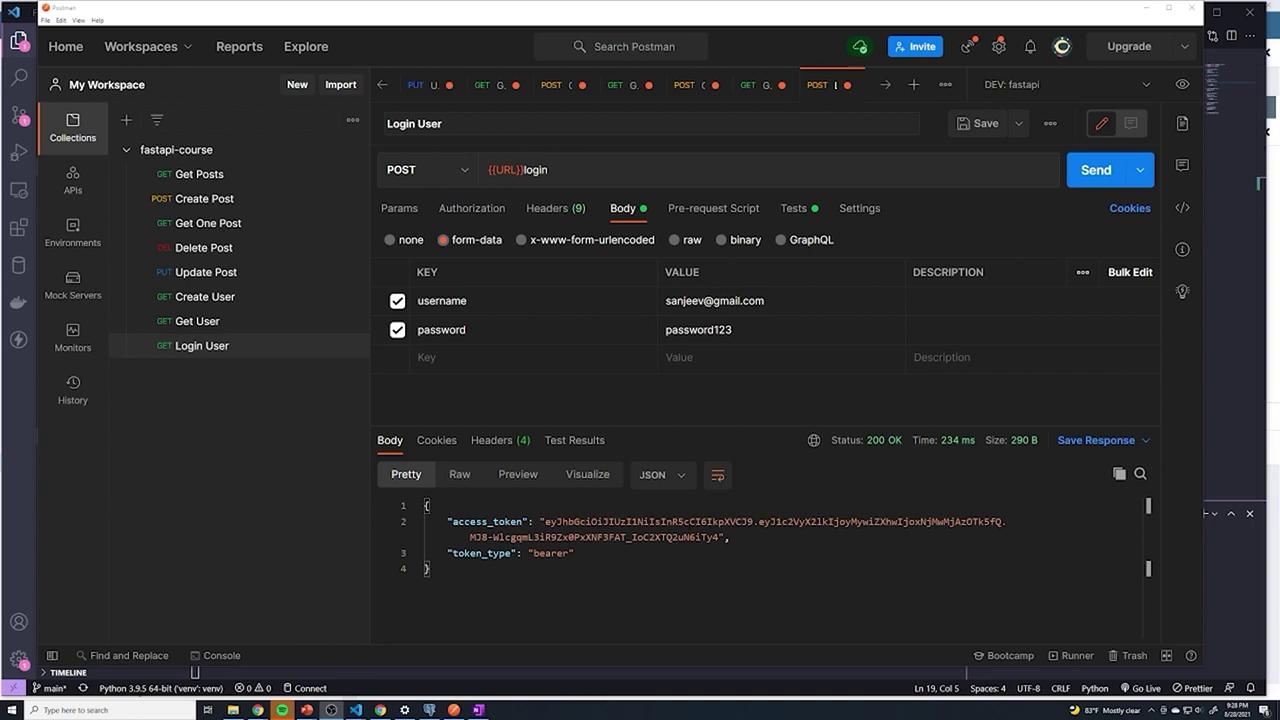
First, we log in a user, update a variable, and retrieve all posts using our Postman Essentials application. The image below illustrates a login request using the POST method with form data for the username and password. The response includes an access token and token type.
When retrieving posts, even though our application currently returns one post, the response does not include the new “owner_id” field. For example, the JSON output appears as follows:
Since the owner ID is a newly added column, our schema must be updated to include it. This field is crucial as it informs users about the creator of the post.
The schema for returning posts is based on PostBase, which currently includes fields like “title”, “content”, and “published”. It also defines the “id” and “created_at” fields that are generated at the database level:
Copy
Ask AI
from datetime import datetimefrom pydantic import BaseModel, EmailStrclass PostBase(BaseModel): title: str content: str published: boolclass Post(PostBase): id: int created_at: datetime class Config: orm_mode = Trueclass UserCreate(BaseModel): email: EmailStr
To include the owner information in the response, we add an “owner_id” field to the output schema. Note that we do not require the owner to supply this field, as it will be derived automatically from the authentication token:
Copy
Ask AI
class Post(PostBase): id: int created_at: datetime owner_id: int class Config: orm_mode = True
After updating the schema, hitting the endpoint returns a response that now includes the “owner_id”:
Logs confirm the successful execution of these endpoints:
Copy
Ask AI
INFO 127.0.0.1:64010 "GET /posts HTTP/1.1" 200 OKINFO 127.0.0.1:64011 "POST /login HTTP/1.1" 307 Temporary RedirectINFO 127.0.0.1:64012 "GET /posts HTTP/1.1" 200 OK
Since all endpoints (retrieving all posts, a single post, creating a post, and updating a post) use the same schema (schemas.Post), updating it once is sufficient.
@router.put("/{id}", response_model=schemas.Post)def update_post(id: int, updated_post: schemas.PostCreate, db: Session = Depends(get_db), current_user: int = Depends(oauth2.get_current_user)): # Logic to update the post goes here ...
After updating, retrieving a post (for example, with ID 4) returns the following JSON response:
This confirms that the “owner_id” is now properly included in the response.
All endpoints currently reference the updated schemas.Post to include owner information. This single change now propagates across various functionalities like retrieving a post, updating a post, and creating a post.
An issue arises when creating a post. If a new post is submitted without an owner ID (since this field is not provided in the request body), the database generates an error due to the NOT NULL constraint on the “owner_id” column:
Copy
Ask AI
File "c:\users\sanje\documents\courses\fastapi\venv\lib\site-packages\sqlalchemy\engine\default.py", line 717, in do_execute cursor.execute(statement, parameters)sqlalchemy.exc.IntegrityError: (psycopg2.errors.NotNullViolation) null value in column "owner_id" violates not-null constraintDETAIL: Failing row contains (5, top beaches in florida, something something beaches, t, 2021-08-28 21:32:22.480381+01, None).[SQL: INSERT INTO posts (title, content, published, owner_id) VALUES (%(title)s, %(content)s, %(published)s, %(owner_id)s) RETURNING posts.id][parameters: {'title': 'top beaches in Florida', 'content': 'something something beaches', 'published': True, 'owner_id': None}](Background on this error at: https://sqlalche.me/e/14/gkpj)
This error indicates that while “owner_id” is mandatory in the database, the current logic does not automatically assign it during post creation. We will address this mechanism in the next article.
By updating the schema to include the “owner_id” field, the response for retrieving posts now provides clearer information about the post creator. However, the process for automatically assigning the owner ID during post creation still requires implementation. Stay tuned for the upcoming article, where we will tackle this issue and refine the owner assignment process.