This article explores recoverable errors in Rust, focusing on error handling patterns using the Result and Option types.
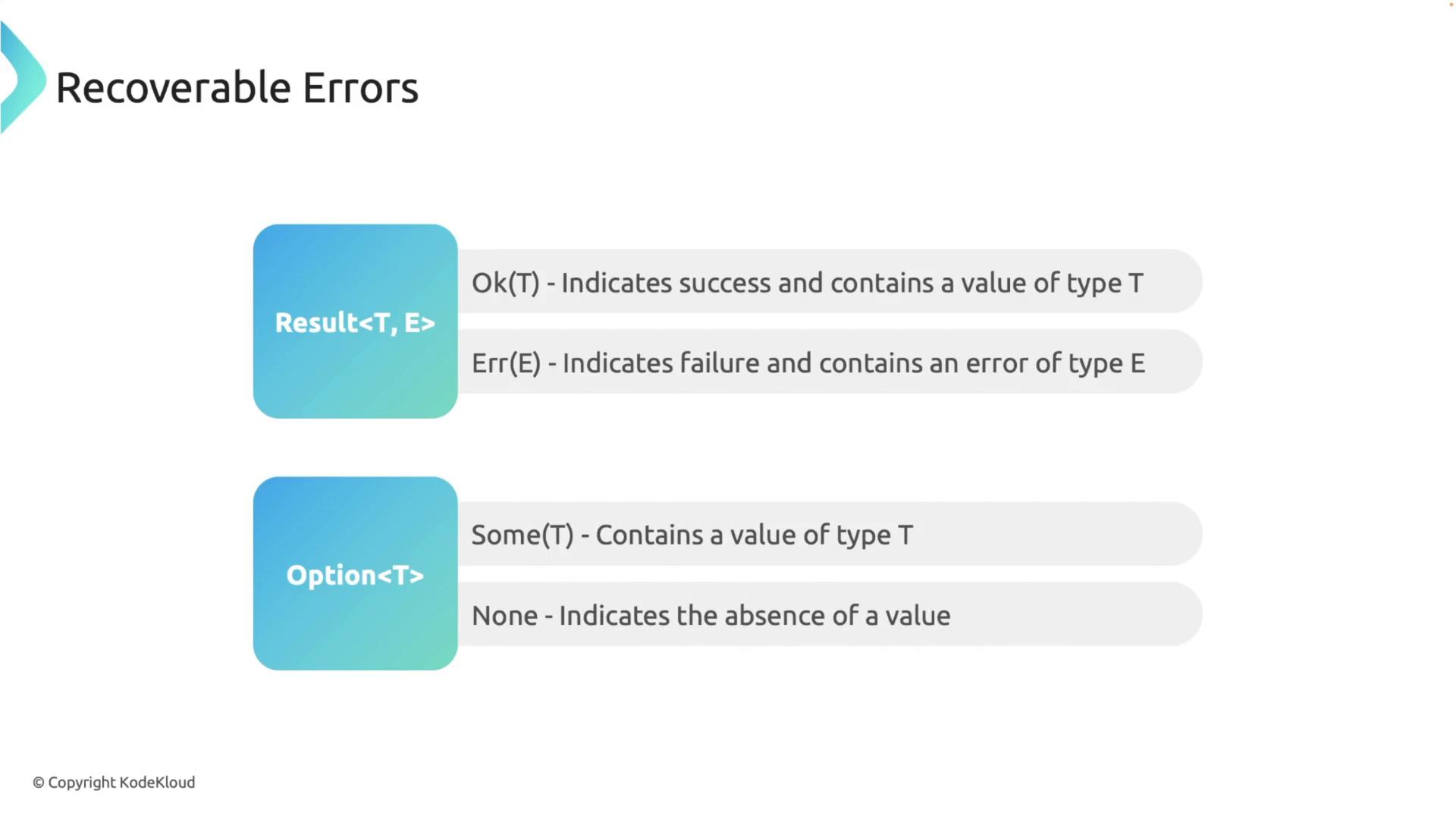
Unlike unrecoverable errors, which force your program to halt immediately, recoverable errors allow you to gracefully handle issues while keeping your application running smoothly. In this lesson, we will explore both basic and advanced error handling patterns in Rust using recoverable errors.Recoverable errors occur when an operation might fail, but the failure can be managed. In Rust, these errors are represented by the standard library’s Result and Option types. The Result type is used for operations that can either succeed (returning an Ok variant) or fail (returning an Err variant). The Option type is useful when a value may be absent, represented by either Some (indicating a valid value) or None.This powerful type system helps prevent common bugs by forcing developers to handle potential errors explicitly.
The Result type is the primary tool for managing recoverable errors in Rust. Consider the following example where the divide function divides two numbers. If the denominator is zero, the function returns an error with an appropriate message; otherwise, it wraps the result in an Ok.
Copy
Ask AI
fn divide(a: i32, b: i32) -> Result<i32, String> { if b == 0 { Err(String::from("Division by zero is not allowed")) } else { Ok(a / b) }}fn main() { let result = divide(10, 2); match result { Ok(value) => println!("Result: {}", value), Err(e) => println!("Error: {}", e), }}
When executed, the output will be:
Copy
Ask AI
Result: 5
This design compels you to consider potential failure points and handle them proactively.
Propagating Errors with the Question Mark Operator
The question mark operator (?) simplifies error handling in functions that return a Result or Option. When used, it checks the value: if it is Ok or Some, it unwraps and returns the inner value; if it is an Err or None, it returns early from the function with that error value.Consider the refactored example below using the question mark operator:
Copy
Ask AI
fn divide(a: f64, b: f64) -> Result<f64, String> { if b == 0.0 { return Err(String::from("Division by zero error")); } Ok(a / b)}fn calculate() -> Result<(), String> { let result = divide(10.0, 0.0)?; println!("Result: {}", result); Ok(())}fn main() { if let Err(e) = calculate() { println!("Failed to calculate: {}", e); }}
The output from this example is:
Copy
Ask AI
Failed to calculate: Division by zero error
In this code, if the divide function returns an error, the ? operator causes an immediate return from the calculate function, skipping any remaining lines.You can chain multiple operations with the ? operator. For example, consider a scenario where you first read a username and then validate it:
Copy
Ask AI
fn read_username() -> Result<String, String> { // Simulate reading from an input source Ok("john_doe".to_string())}fn validate_username(username: &str) -> Result<(), String> { if username == "john_doe" { Ok(()) } else { Err("Invalid username".to_string()) }}fn main() -> Result<(), String> { let username = read_username()?; // Propagate error if reading fails validate_username(&username)?; // Propagate error if validation fails println!("Username is valid!"); Ok(())}
If either read_username or validate_username fails, the error is immediately returned from the main function.
The unwrap_or_else method offers fallback behavior when dealing with Result or Option types that encounter an error or an absence of a value. This method is ideal for logging errors, returning default values, or computing a fallback value based on the error.
In this example, the Option value is None, so the closure passed to unwrap_or_else executes and returns a default value:
Copy
Ask AI
fn main() { let opt: Option<i32> = None; let value = opt.unwrap_or_else(|| { println!("No value found, returning default"); 10 // Default value when `opt` is None }); println!("The value is: {}", value);}
For a Result, the closure receives the error as an argument. In this scenario, the operation fails, and the closure provides a fallback value:
Copy
Ask AI
fn main() { let result: Result<i32, &str> = Err("An error occurred"); let value = result.unwrap_or_else(|err| { println!("Error encountered: {}", err); -1 // Fallback value if `result` is Err }); println!("The result is: {}", value);}
The output will be:
Copy
Ask AI
Error encountered: An error occurredThe result is: -1
Consider the following consolidated example, which demonstrates the use of both Result and Option along with the unwrap_or_else method:
Copy
Ask AI
// Function that returns a Result for a division operationfn divide(a: f64, b: f64) -> Result<f64, String> { if b == 0.0 { Err(String::from("Division by zero error")) } else { Ok(a / b) }}// Function that returns an Option for computing a square rootfn find_square_root(x: f64) -> Option<f64> { if x < 0.0 { None // Negative numbers don't have real square roots } else { Some(x.sqrt()) }}fn main() { // Handling Result with unwrap_or_else let division_result = divide(10.0, 0.0).unwrap_or_else(|err| { println!("Error in division: {}", err); 0.0 // Fallback value on error }); println!("Division result: {}", division_result); // Handling Option with unwrap_or_else let sqrt_result = find_square_root(-9.0).unwrap_or_else(|| { println!("Error: Cannot find the square root of a negative number."); 0.0 // Fallback value when no result is available }); println!("Square root result: {}", sqrt_result);}
The console output after running the program is:
Copy
Ask AI
Error in division: Division by zero errorDivision result: 0Error: Cannot find the square root of a negative number.Square root result: 0
By following these techniques, you ensure your Rust applications can handle errors robustly, allowing them to continue operating smoothly even under unexpected conditions.