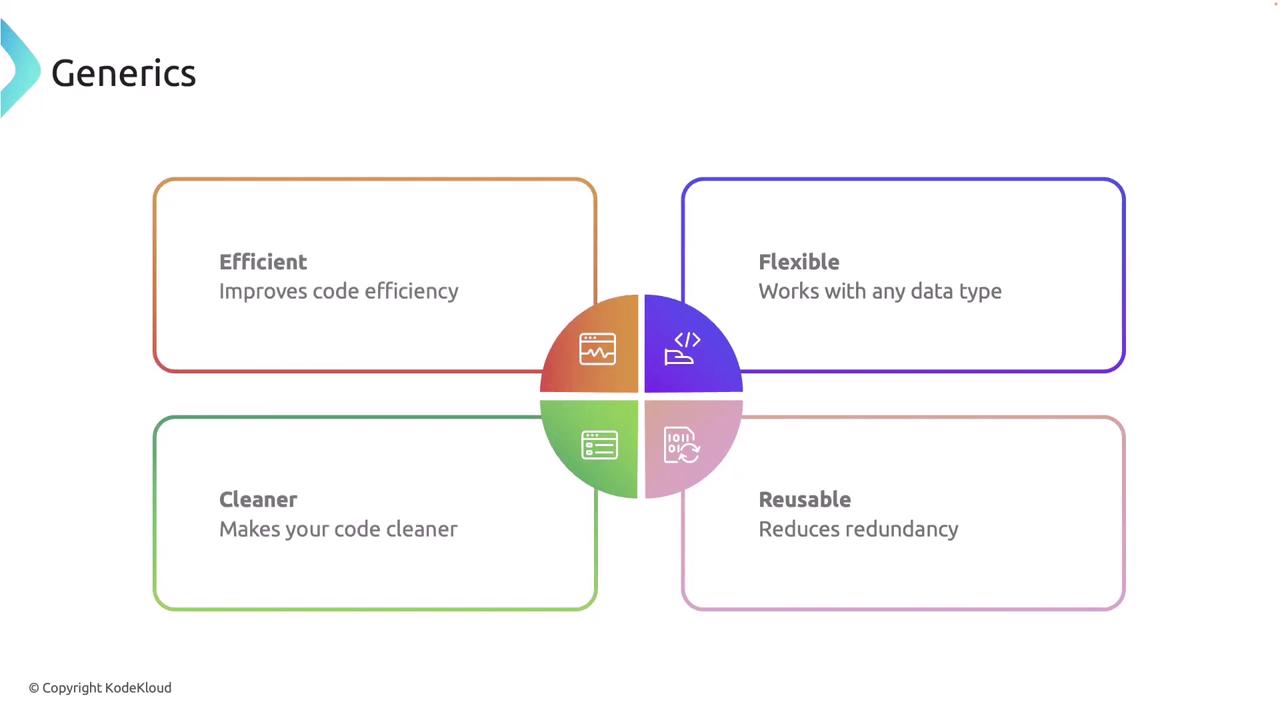
Discover how generics in Rust help you write flexible, reusable, and efficient code while reducing code duplication and improving maintainability.
Discover how generics in Rust help you write flexible, reusable, and efficient code. Generics allow your functions, structs, enums, and methods to work with any data type. This reduces code duplication and makes your projects easier to maintain. In this guide, we will explore various aspects of generics and discuss performance considerations.
Generics empower you to write functions that are not restricted to a single data type. Instead of implementing separate functions for different types, you can create one generic function that accommodates any input.Below is an example that demonstrates non-generic functions versus a generic function using Python-like syntax for illustration:
Copy
Ask AI
# Non-generic functions to print specific typesdef print_integer(num: int): print(num)def print_string(text: str): print(text)# Generic function to print any type of datadef print_item(item): print(item)# Usageprint_integer(5)print_string("Hello")print_item(5)print_item("Hello")
Using a generic function like print_item prevents code redundancy and maintains consistency. Now, let’s take a look at a Rust implementation that returns the first element of a slice regardless of its type:
Copy
Ask AI
fn first_element<T>(list: &[T]) -> Option<&T> { if list.is_empty() { None } else { Some(&list[0]) }}fn main() { let numbers: Vec<i32> = vec![1, 2, 3]; let words: Vec<&str> = vec!["apple", "banana", "cherry"]; if let Some(first) = first_element(&numbers) { println!("First number: {}", first); } if let Some(first) = first_element(&words) { println!("First word: {}", first); }}
In this Rust example, the generic type parameter T allows the function to handle slices containing any type. The return type is Option<&T>, which gracefully deals with the possibility of an empty slice.
You may sometimes need to mix generic fields with fields that have fixed types. For example, if you want to add a mandatory i32 field to your struct, you can do so while still using generics:
Enums in Rust can also leverage generics to represent multiple types. For instance, consider a custom Result type that encapsulates either a success result or an error message:
Copy
Ask AI
enum MyResult<T, E> { Ok(T), Err(E),}fn main() { let success: MyResult<i32, &str> = MyResult::Ok(200); let error: MyResult<i32, &str> = MyResult::Err("Something went wrong"); match success { MyResult::Ok(value) => println!("Success with value: {}", value), MyResult::Err(err) => println!("Error: {}", err), } match error { MyResult::Ok(value) => println!("Success with value: {}", value), MyResult::Err(err) => println!("Error: {}", err), }}
Here, T represents the type for a successful result and E represents the error type, providing a robust way to handle different outcomes.
Generic methods on structs allow you to implement functionality that works across various types. For example, consider a method to swap the two values in a Pair struct. This method consumes the original struct and returns a new one with swapped values:
Rust uses a process called monomorphization during compilation to generate type-specific versions of your generic code. This ensures that there is no runtime overhead, and your generic code performs as efficiently as if it were written specifically for each type.
Generics in Rust enable you to create versatile, clean, and high-performance code. By leveraging generics in functions, structs, enums, and methods, you can reduce duplication and build robust libraries that work seamlessly with various data types.For further reading, check out these resources: