

Overview
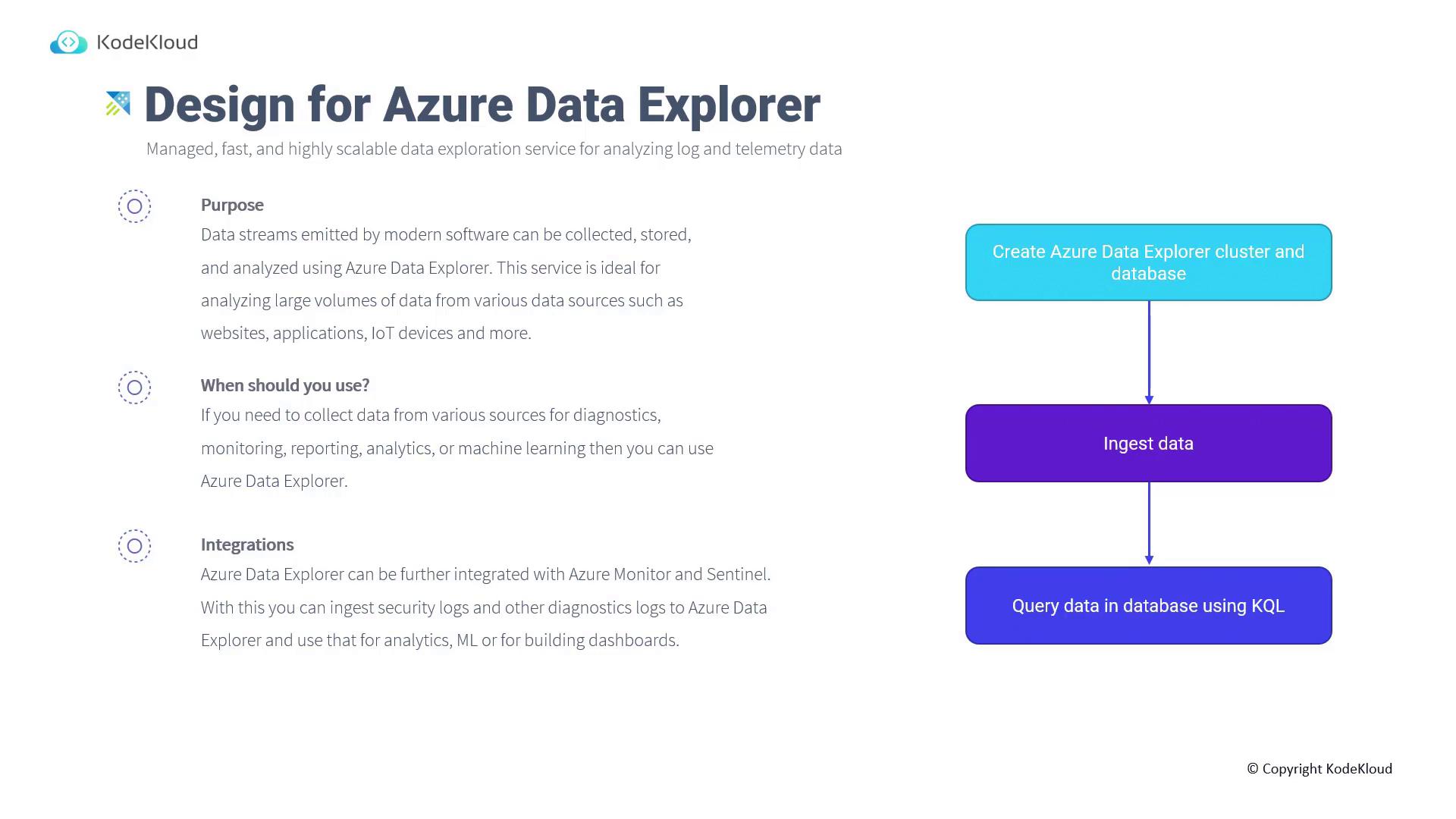
Azure Data Explorer operates through a simple three-step process:- Create a Data Explorer cluster and an associated database in Azure.
- Ingest data from a variety of sources.
- Query the ingested data using KQL.
For more detailed insights into setting up your Data Explorer cluster, please refer to the Azure Data Explorer Documentation.
Purpose and Use Cases
Modern software ecosystems generate vast amounts of data from websites, applications, IoT devices, and more. Azure Data Explorer is engineered to efficiently collect, store, and analyze these extensive data sets. It is particularly useful for scenarios including:- Diagnostics and monitoring
- Reporting and analytics
- Preparation for machine learning tasks
Integrations
Azure Data Explorer integrates seamlessly with other Azure services such as Azure Monitor and Sentinel. This interoperability enables you to ingest security logs and diagnostic data for comprehensive analysis. Key integration features include:- Quick, near real-time analytics
- Time series analysis
- Anomaly detection and forecasting
Real-Time Analytics and Machine Learning
Azure Data Explorer provides enhanced flexibility for building near real-time analytics solutions. It supports advanced analysis techniques, such as:- Time series analysis
- Anomaly detection
- Forecasting
Cost-Effectiveness
A major advantage of Azure Data Explorer is its cost-effective long-term data retention capability. The service offers:- Low-cost, long-term storage for logs and telemetry data
- An ideal centralized repository for complex analytics scenarios
When planning your Azure infrastructure, consider Azure Data Explorer for efficient data retention and processing, helping reduce overall costs while scaling analytics solutions.