

Dynamic Mapping
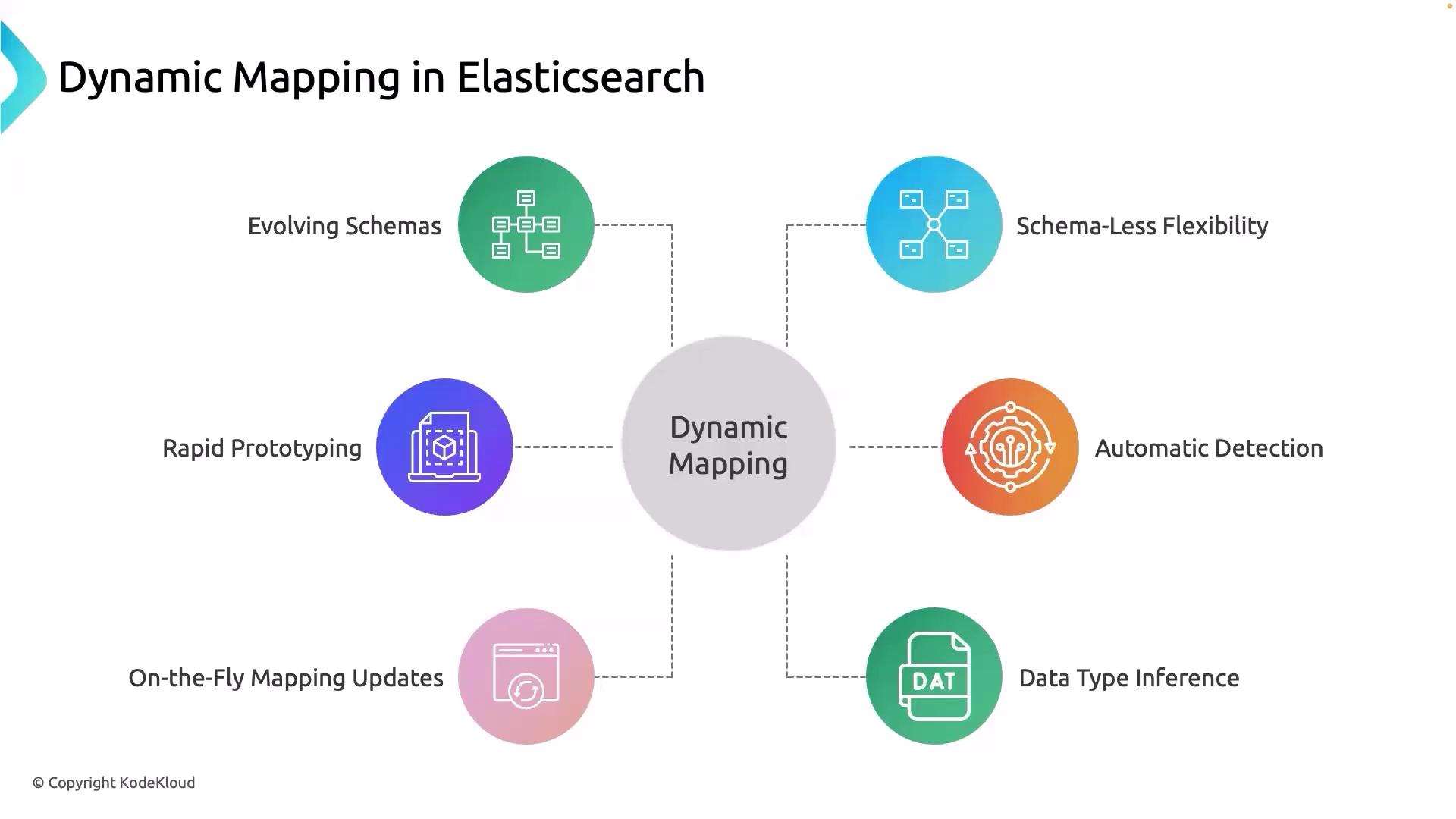
Dynamic mapping allows Elasticsearch to automatically detect and assign data types as new documents are ingested. This feature enables you to deploy data without predefined schemas, as Elasticsearch intelligently infers the data types for each field. Consider the following JSON document:Dynamic mapping is ideal for rapid prototyping and agile development since it seamlessly handles changes and automatically adjusts to new data structures.
- Automatic Detection: New fields are automatically recognized and assigned appropriate data types (e.g., string, number, date, boolean).
- Real-Time Updates: The index mapping is updated on the fly, enabling immediate queries on newly added fields.
- Data Type Inference: Elasticsearch employs intelligent algorithms to determine the correct data type, ensuring optimal indexing and query speed.
- Evolving Schemas: As your data evolves, Elasticsearch adapts without requiring manual intervention.
Explicit Mapping
While dynamic mapping offers excellent flexibility, there are scenarios where precise control over data indexing is necessary. Explicit mapping provides this control by allowing you to define the schema before inserting any data, ensuring that each field is mapped exactly as intended. For instance, if you want to create a customized schema for a product index, you can define your mapping as follows:- The
product_idfield is set as a keyword to ensure exact matching. - The
namefield utilizes the English analyzer to enhance search relevancy. - The
release_datefield is precisely defined as a date following theyyyy-MM-ddformat.
- Control and Precision: You have complete control over field storage and indexing, which can enhance search performance.
- Accurate Data Types: Manually defining data types reduces the risk of type inference errors.
- Customized Analyzers: Tailor text analyzers to meet your specific search and relevancy requirements.
- Schema Evolution Management: While updates must be made manually, this approach ensures consistency and accuracy as your data evolves.
Dynamic mapping is typically the default approach, particularly when setting up a new Elasticsearch cluster. As your application scales and demands more refined search capabilities, transitioning to explicit mapping can significantly improve search accuracy and performance.