This article provides a high-level review of AWS networking components and their integration for a robust networking solution.
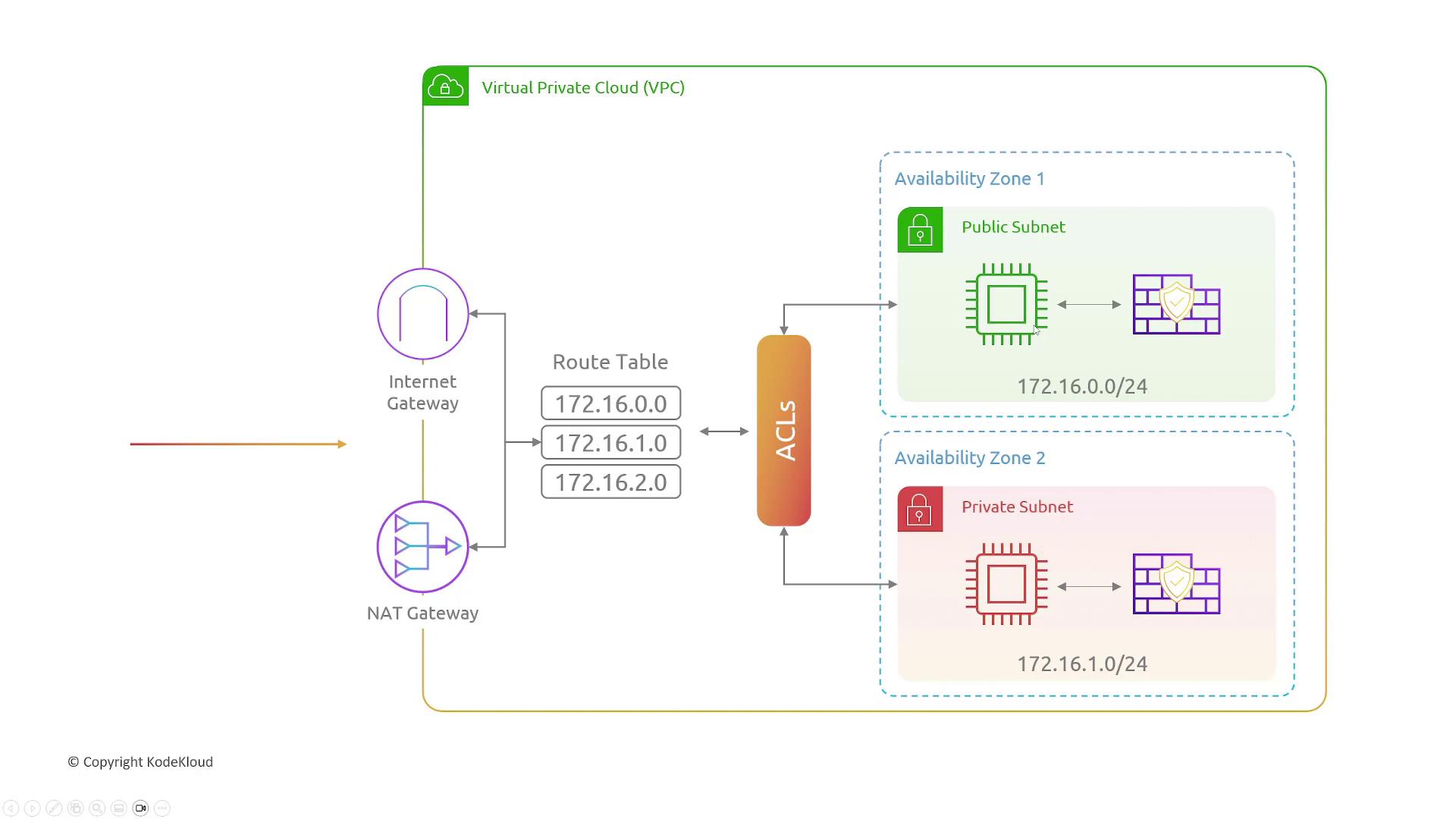
This article provides a high-level review of AWS networking components and demonstrates how they integrate to form a robust networking solution.The diagram below illustrates key AWS networking features and their interactions. It highlights that your AWS Virtual Private Cloud (VPC) is region-specific. Within the VPC, you deploy subnets that align with specific availability zones. For example, one subnet may be linked to Availability Zone 1 and another to Availability Zone 2, ensuring that resources such as servers are strategically placed across the infrastructure.
Each resource within a subnet is assigned a security group, which acts as a dedicated firewall controlling inbound and outbound traffic for that resource. This ensures that only authorized communication occurs.In addition to security groups, AWS employs network access control lists (ACLs) to manage traffic between subnets. While security groups secure individual resources, network ACLs provide a broader layer of traffic filtering for the entire subnet.Two critical components for routing traffic into and out of the VPC are the Internet Gateway and the NAT Gateway:
The Internet Gateway enables direct communication between your VPC and the Internet.
The NAT Gateway is designed to allow outbound connections from resources inside the VPC, while ensuring that unsolicited inbound traffic does not reach those resources.
Additionally, AWS uses route tables—a core element of its network routing—to manage traffic flow within the VPC. For example, you can configure route tables to direct traffic from a server destined for the Internet through a specific intermediary server, offering enhanced control over resource interactions.
Understanding how security groups, network ACLs, gateways, and route tables work together is key to designing a secure and efficient AWS network architecture.
Creating a VPC to host your application infrastructure
Subnet
Segregates VPC into distinct availability zones
Deploying servers in different availability zones
Security Group
Acts as a firewall for individual resources
Controlling traffic to and from an EC2 instance
Network ACL
Filters traffic at the subnet level
Setting rules for all resources within a subnet
Internet Gateway
Enables direct Internet communication
Allowing public access to web servers
NAT Gateway
Permits outbound communication from private subnets
Securely connecting private instances to the Internet
Route Table
Directs traffic flow within the VPC
Routing traffic through a specific server or gateway
Overall, this architecture demonstrates how VPCs, subnets, security groups, network ACLs, gateways, and route tables work in concert to deliver a secure and efficient networking environment on AWS.For more detailed information on AWS networking, visit the AWS Networking Documentation.