This guide explores API priority and fairness, pod priority and preemption, and strategies for configuring DNS in multi-tenant Kubernetes environments.
In multi-tenant Kubernetes environments, managing workload priorities is critical for ensuring that both the control plane and node resources are allocated efficiently. In this guide, we explore key concepts such as API priority and fairness, pod priority and preemption, and strategies for configuring DNS in a multi-tenant setup.
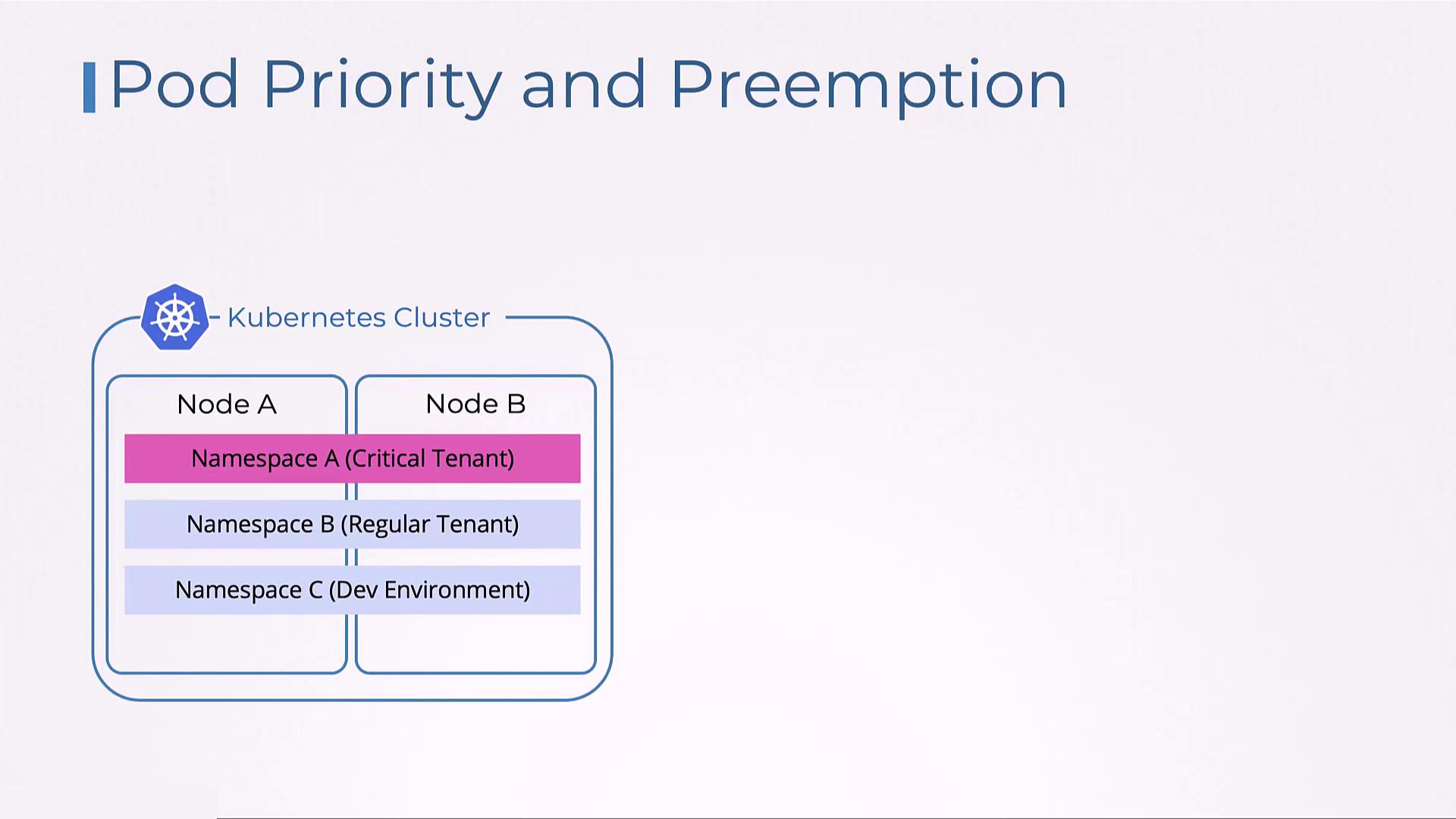
Kubernetes processes all resource management operations through its singular API endpoint. This makes the API a focal point for managing requests like creating namespaces, scaling applications, and updating deployments. In clusters supporting multiple tenants—with varying levels of application criticality—it is crucial to ensure that essential API requests receive higher priority.Consider a scenario with two tenants sharing a cluster. Tenant A (in namespace A) runs critical services that require rapid scaling, while Tenant B (in namespace B) handles less critical workloads. To avoid delays in request handling for Tenant A due to Tenant B’s traffic, Kubernetes allows configuring API priority and fairness settings.
You first define priority level configurations using the beta API from flowcontrol.apiserver.k8s.io/v1beta3. In the configuration below, the “high-priority” level is allocated a higher assured concurrency than the “low-priority” level:
Next, create FlowSchema objects that map these priority levels to specific tenant requests. The following example assigns higher precedence to namespace A (critical tenant) over namespace B:
Copy
Ask AI
apiVersion: flowcontrol.apiserver.k8s.io/v1beta3kind: FlowSchemametadata: name: high-priority-namespace-aspec: priorityLevelConfiguration: name: high-priority # Link to high priority matchingPrecedence: 1000 rules: - subjects: - kind: ServiceAccount name: "system-account" # Alternatively, match on user or service account namespace: "namespace-a" # Target Namespace A resourceRules: - verbs: ["*"] apiGroups: ["*"] resources: ["*"]---apiVersion: flowcontrol.apiserver.k8s.io/v1beta3kind: FlowSchemametadata: name: low-priority-namespace-bspec: priorityLevelConfiguration: name: low-priority # Link to low priority matchingPrecedence: 2000 rules: - subjects: - kind: Group name: "regular-users" - kind: ServiceAccount name: "default" namespace: "namespace-b" # Target Namespace B resourceRules: - verbs: ["*"] apiGroups: ["*"] resources: ["*"]
This configuration ensures that API requests from critical namespaces are prioritized, preserving the responsiveness of essential operations.
Beyond API request handling, Kubernetes also supports pod priority and preemption to manage node resource allocation (including CPU, memory, etc.). This mechanism guarantees that critical pods gain necessary resources, even under resource pressure, by preempting or evicting less critical pods when needed.
For example, if Tenant A (running critical workloads in namespace A) needs to ensure constant operation of production databases or core services, pod priority and preemption help maintain resource allocation, even if lower-priority Tenant B jobs are affected.
Begin by defining priority classes that distinguish between critical and non-critical workloads. In the configuration below, the “high-priority” class is assigned a higher value, ensuring its pods are scheduled preferentially:
Copy
Ask AI
apiVersion: scheduling.k8s.io/v1kind: PriorityClassmetadata: name: high-priorityvalue: 1000 # High priority for critical workloadsglobalDefault: falsedescription: "This priority class is for critical production workloads."---apiVersion: scheduling.k8s.io/v1kind: PriorityClassmetadata: name: low-priorityvalue: 100 # Low priority for non-critical tasksglobalDefault: falsedescription: "This priority class is for non-critical development workloads."
Then, assign the appropriate priority class to your pod specifications. The following example shows how to define a critical application pod in namespace A:
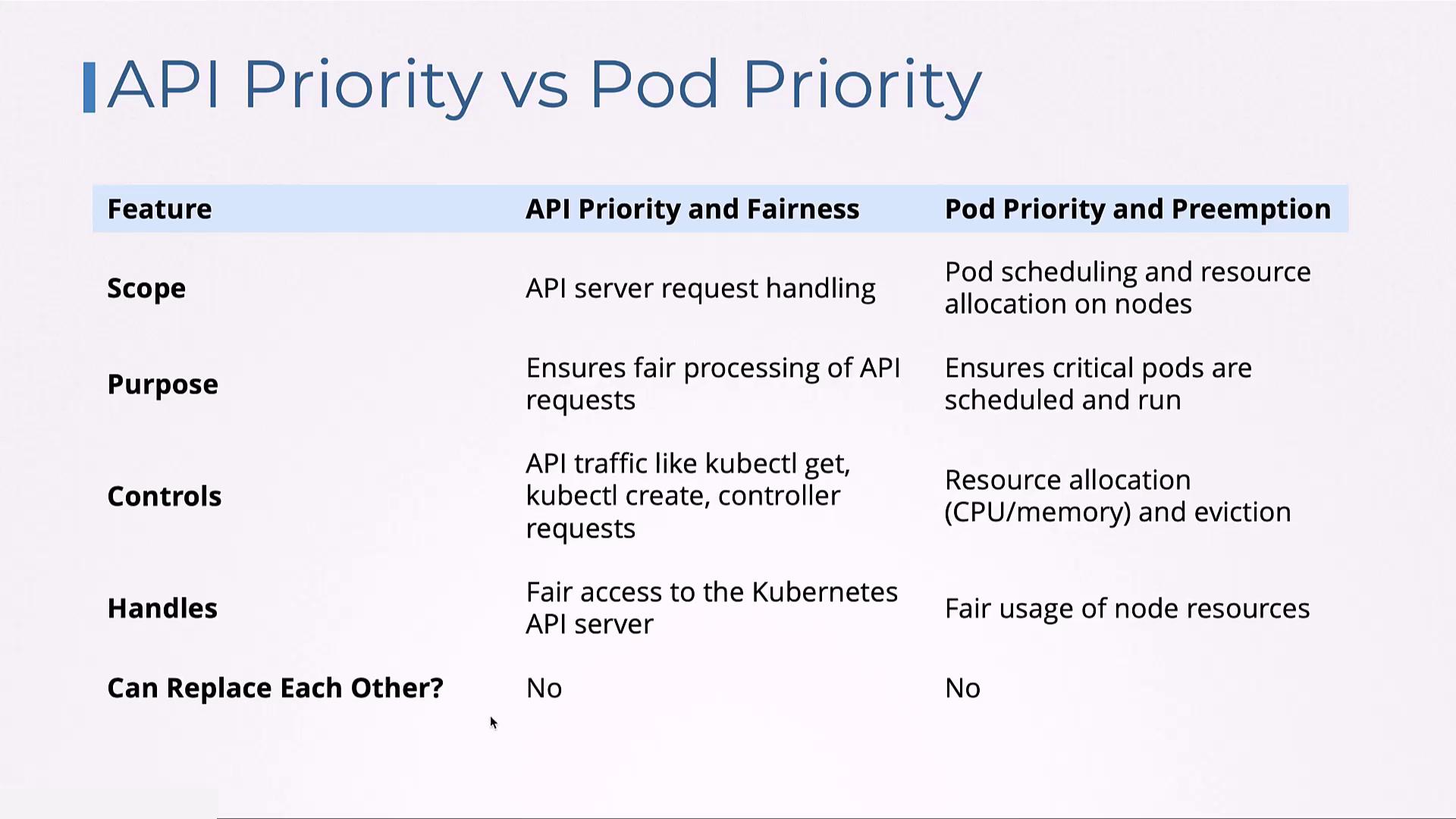
Both API priority and pod priority serve crucial yet distinct roles within a Kubernetes cluster:
API Priority and Fairness:
These settings control the flow and processing of Kubernetes API requests. They manage operations such as creating, updating, or fetching cluster resources and ensure that critical API interactions are not stalled by heavy traffic from lower priority sources.
Pod Priority and Preemption:
These mechanisms focus on resource allocation at the node level. They prioritize scheduling for critical pods and allow the system to evict lower priority pods when essential resources are required.
Below is a comparative illustration clarifying the roles of API priority versus pod priority:
Both mechanisms are integral for the stability and performance of multi-tenant clusters. It is important to carefully plan and test your configurations to ensure critical workloads receive the intended level of service.
By understanding and appropriately implementing API priority and pod priority configurations, you can effectively manage resource contention and maintain service quality across multi-tenant Kubernetes environments.For more insights on Kubernetes configuration and best practices, refer to the Kubernetes Documentation.