

OutputParser, you can automate this workflow end-to-end.
Why Structured Output Matters
- Interoperability: Structured data (JSON, XML, YAML) integrates seamlessly with APIs and databases.
- Reliability: Reduces parsing errors and unexpected values at runtime.
- Maintainability: Clear schemas make it easier to validate and extend your data model.
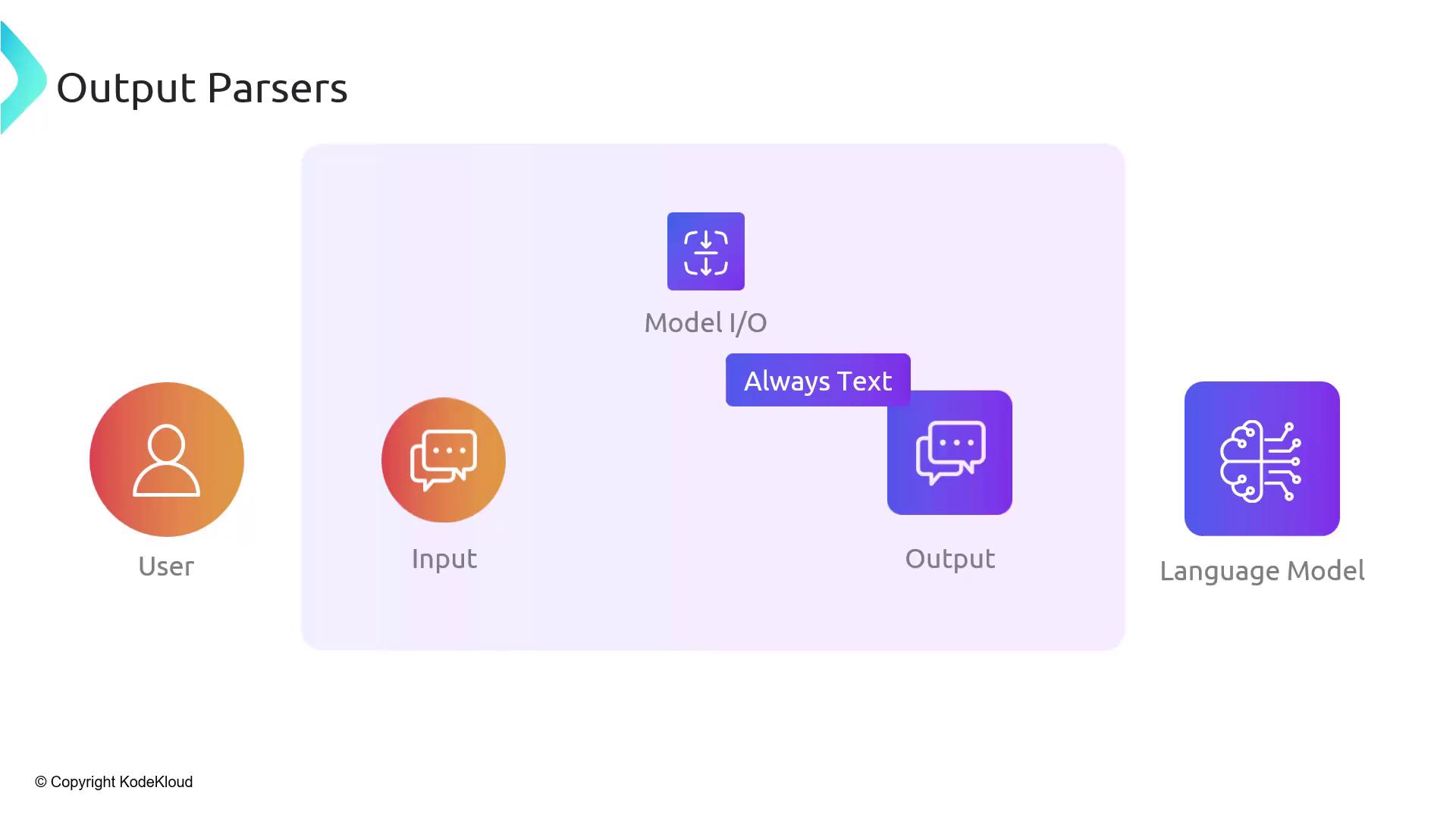
Large language models always return text. To work with objects, you need to parse and validate that text.
How LangChain’s OutputParser Works
LangChain’sOutputParser automates both prompt construction and response transformation:
-
Prompt Construction
You define a schema and example responses inside aPromptTemplate. The model then knows exactly which structure (e.g., JSON with specific fields) to produce. -
Response Transformation
After receiving the text output, the parser converts it into your target data type (e.g., Pythondict, XML DOM, YAML mapping), handling parsing errors and edge cases.

Common Output Formats
| Format | Description | Example |
|---|---|---|
| JSON | Widely used, machine-readable | { "name": "Alice", "age": 30 } |
| XML | Markup-based, verbose | <person><name>Alice</name></person> |
| YAML | Human-friendly, indentation-based | name: Alice |
| CSV | Tabular data, comma-separated | name,age\nAlice,30 |
Benefits of Using OutputParser
- Predictability: Enforces schema so you avoid malformed data.
- Error Handling: Catches parsing exceptions early and returns structured error messages.
- Extensibility: Easily swap or update schemas without rewriting parsing logic.
Always include
format_instructions from StructuredOutputParser in your prompt. Omitting them can lead to inconsistent model responses and parsing failures.Next Steps
- Experiment with custom
ResponseSchemadefinitions for your use case. - Validate parsed output against JSON Schema or your own validators.
- Integrate the parser into your production pipeline for reliable data ingestion.