

Potential Causes
1. Spot Price Fluctuations
Spot Instances are acquired through a bidding process and can be terminated if the market price exceeds your bid value. This means that if the current Spot price climbs above your configured bid, your ASG may fail to provision new nodes. Keep in mind that bidding higher only improves the likelihood of acquiring an instance; it does not guarantee successful provisioning.Spot Instance pricing is dynamic. Regular monitoring of market trends and adjusting bid values can help mitigate interruptions.
2. EC2 Quota Limits
AWS enforces soft limits on the number of EC2 instances per account to ensure resource control and prevent unexpected charges. Even with a sound bidding strategy, hitting your EC2 quota can prevent new nodes from being provisioned. In such scenarios, you can resolve the issue by reaching out to AWS Support to request an increase in your EC2 instance quota.Always check your current EC2 instance limits before scaling. Contact AWS Support if you frequently approach the quota threshold to ensure uninterrupted scaling.
Diagram Explanation
Below is a diagram that illustrates Spot Instance pricing for the R4xLarge instance type. Imagine an ASG configured exclusively with R4xLarge instances. If you’re operating in a specific availability zone (highlighted in green), and your bid price is lower than the current Spot price, the ASG may lose all its instances. This diagram highlights the inherent risk of relying solely on Spot Instances.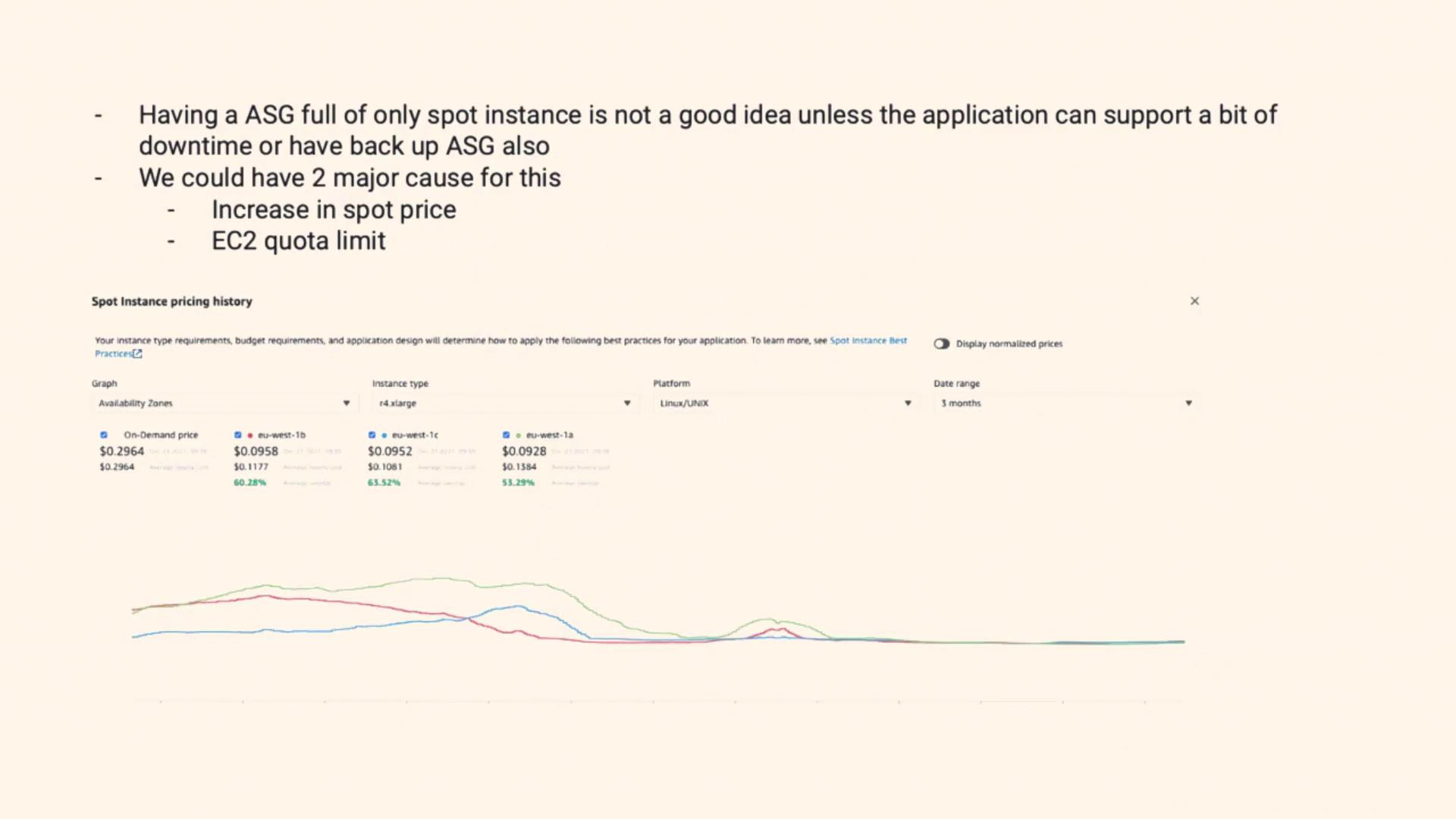
Interview Approach
When discussing this topic in an interview, consider the following points:- The primary issue may be that Spot Instance prices have risen beyond the configured bid value, leading to provisioning challenges.
- Another potential cause is hitting the EC2 quota limit imposed by AWS.
- A practical resolution for quota-related issues is to contact AWS Support and request a quota increase.