

Licensing and Governance
OpenTofu is published under the permissive MIT License, ensuring that users retain full freedom to inspect, modify, and distribute the code. In contrast, Terraform is governed by HashiCorp under the Mozilla Public License 2.0, which enforces certain copyleft requirements.| Project | License | Governance Model |
|---|---|---|
| OpenTofu | MIT License | Community-driven with an impartial maintainer team |
| Terraform | MPL 2.0 | Core development steered by HashiCorp |
Terraform’s copyleft license may impose obligations on derivative works, potentially impacting closed-source or enterprise workflows.
Feature Prioritization
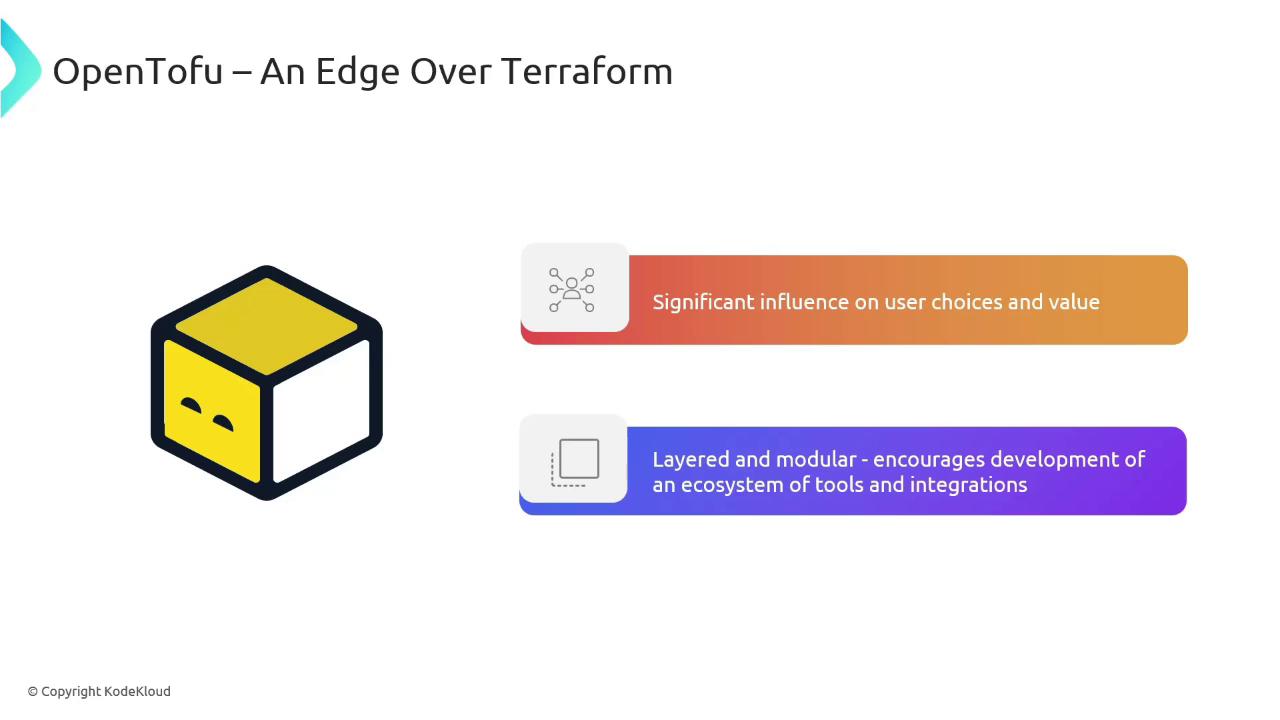
OpenTofu’s feature roadmap is shaped by its contributors. Instead of vendor-driven timelines, priorities emerge from public discussions and GitHub issues:- New features are proposed, debated, and triaged in the open.
- Contributors cast votes via issue reactions, ensuring top-requested items rise to the top.
- Community meetings and regular working groups keep development aligned with real-world use cases.
Explore the full OpenTofu roadmap and issue tracker to see how you can influence upcoming releases.
Layered, Modular Architecture
OpenTofu’s codebase is carefully partitioned into distinct layers and modules. This structure makes it straightforward to:- Develop new plugins, provisioners, and backends.
- Navigate the repository and identify extension points.
- Build a rich ecosystem of complementary tools for Terraform-style workflows.
Links and References
- GitHub: OpenTofu Repository
- Terraform Official Site: https://www.terraform.io/
- OpenTofu License: https://github.com/opentofu/opentofu/blob/main/LICENSE
- Terraform License: https://github.com/hashicorp/terraform/blob/main/LICENSE
- Kubernetes Basics: https://kubernetes.io/docs/concepts/overview/what-is-kubernetes/