

Introduction
Apache Kafka scales message processing by distributing partitions across multiple consumers. In this article, we’ll explain what consumer groups are, how they balance work, and why they’re key to parallel processing, ordered delivery, and fault tolerance in real-time data pipelines.Producers vs. Consumers
Before diving into consumer groups, let’s recap the core roles in Kafka:| Role | Responsibility | Example |
|---|---|---|
| Producer | Sends event records to Kafka topics | producer.send("Topic A", record) |
| Consumer | Reads and processes records from Kafka partitions | consumer.poll(Duration.ofMillis(100)) |
- Fetch event from Partition 1
- Process the event
- Continue with the next event in Partition 1 (or switch to Partition 2 after finishing Partition 1)
What Is a Consumer Group?
A consumer group is a set of consumers sharing the samegroup.id. Kafka divides topic partitions among group members so each event is consumed exactly once by the group. This lets you scale horizontally without duplicate processing.
Assign the same
group.id to all consumers in your application to enable coordinated partition assignment.Partition Assignment in Action
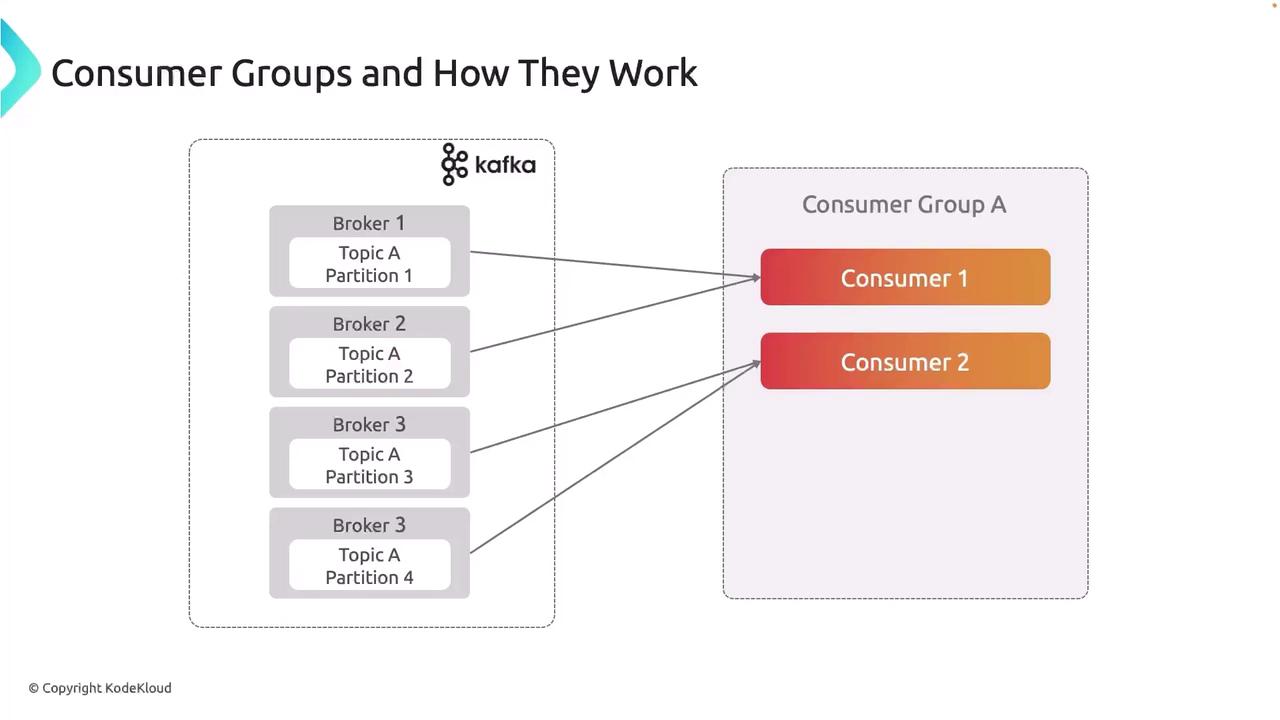
When two consumers join a group for Topic A (4 partitions), Kafka automatically balances the load:- Consumer 1: Partitions 1 & 2
- Consumer 2: Partitions 3 & 4
Scaling with More Consumers
You can add up to as many consumers as there are partitions. Kafka dynamically rebalances so each active consumer handles one or more partitions: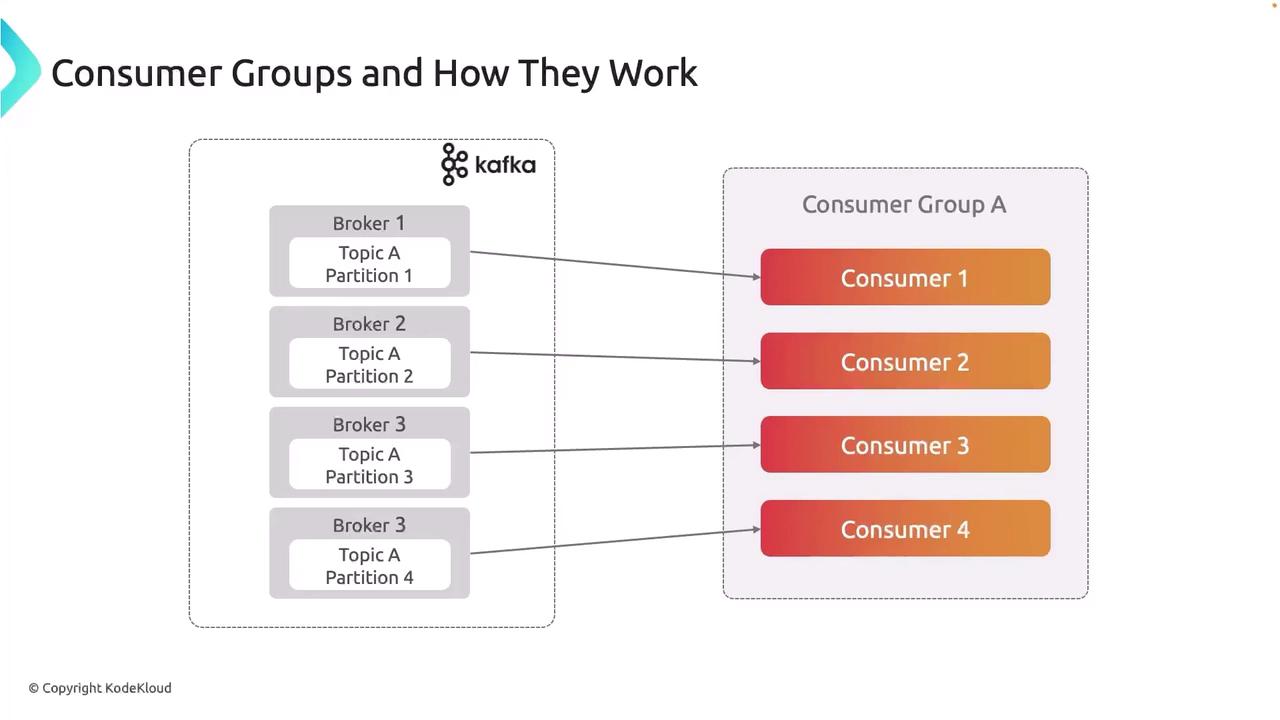
Adding more consumers than partitions will leave some consumers idle until new partitions become available.
Core Features of Consumer Groups
-
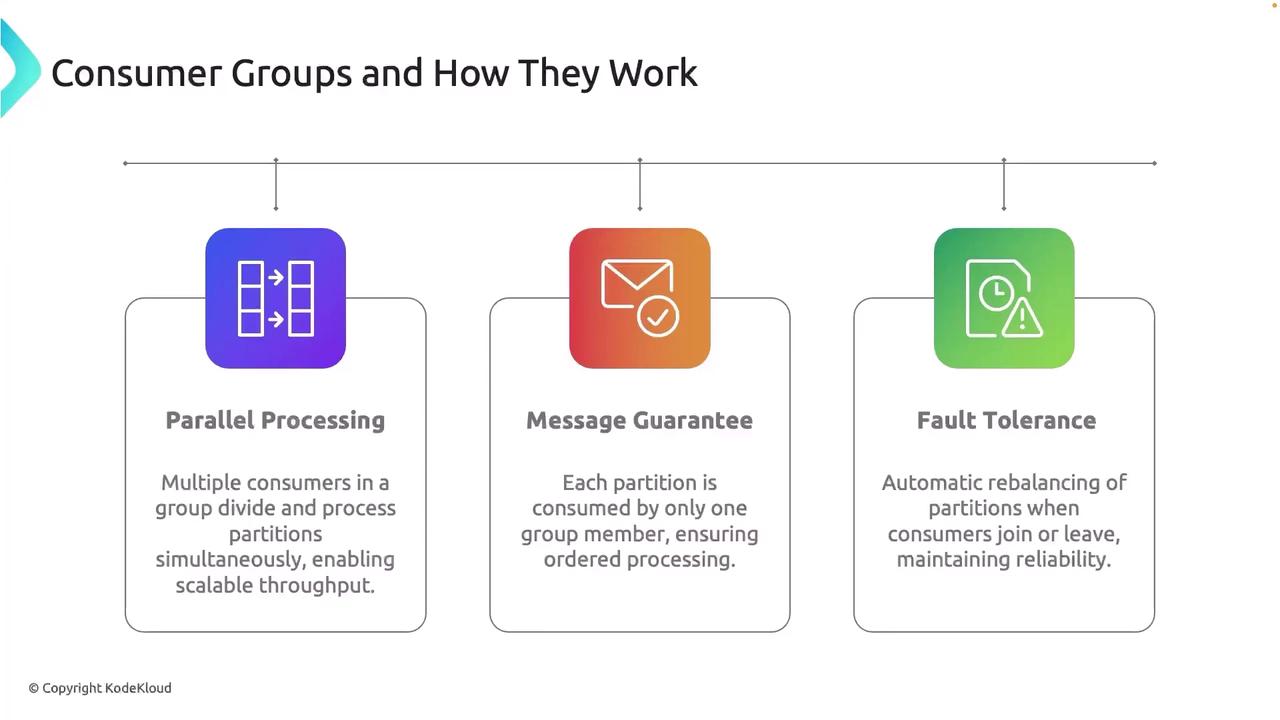
Parallel Processing
Multiple consumers read from different partitions simultaneously, boosting throughput. -
Message Guarantee
Exactly one consumer per partition ensures ordered delivery and no duplicates. -
Fault Tolerance
If a consumer fails, Kafka rebalances partitions among the remaining members, minimizing disruption.
Coordination, Scaling, and Rebalancing
Kafka brokers (via KRaft or ZooKeeper) handle group membership, partition assignments, and rebalances: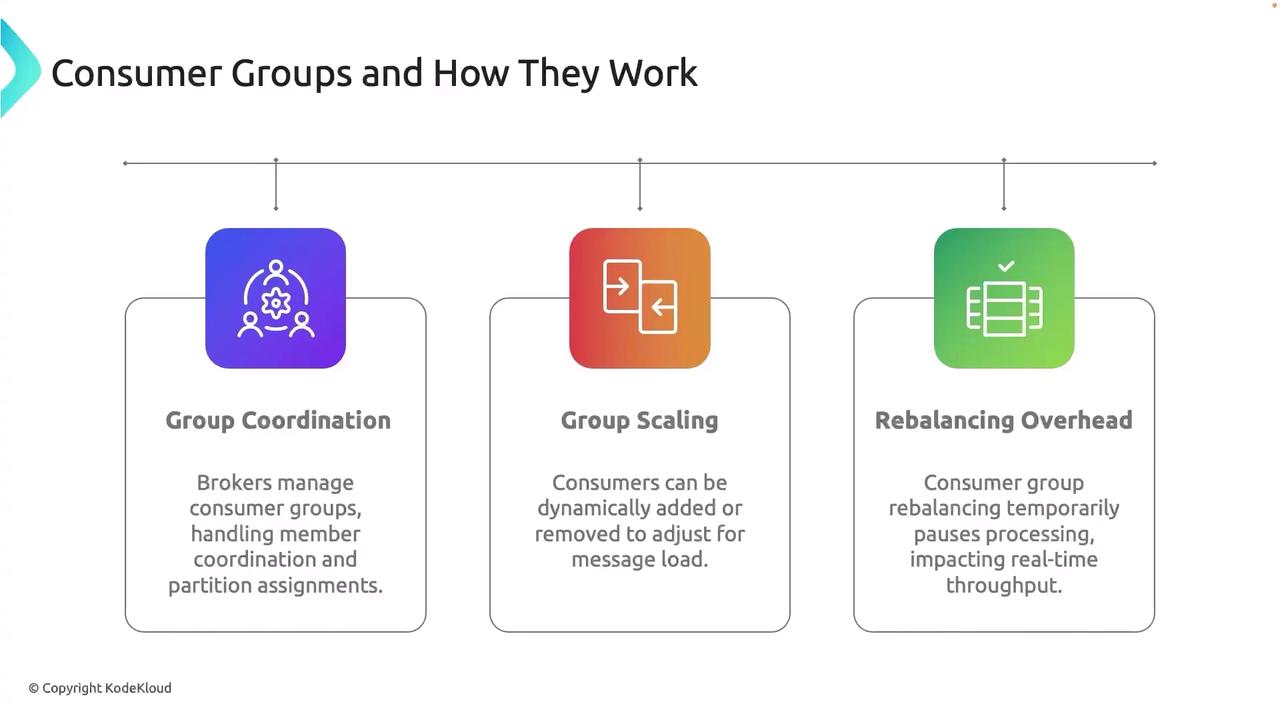
- Group Coordination
Brokers detect active consumers, assign partitions, and monitor heartbeats. - Dynamic Scaling
Add or remove consumers at runtime to match workload without downtime. - Rebalancing Overhead
On membership changes, brokers briefly pause consumption to redistribute partitions.