This article explores the Amazon EKS control plane components and their management for launching an EKS cluster.
In this lesson/article, we’ll delve into the Amazon EKS control plane and examine every component AWS provisions and manages when you launch an EKS cluster.
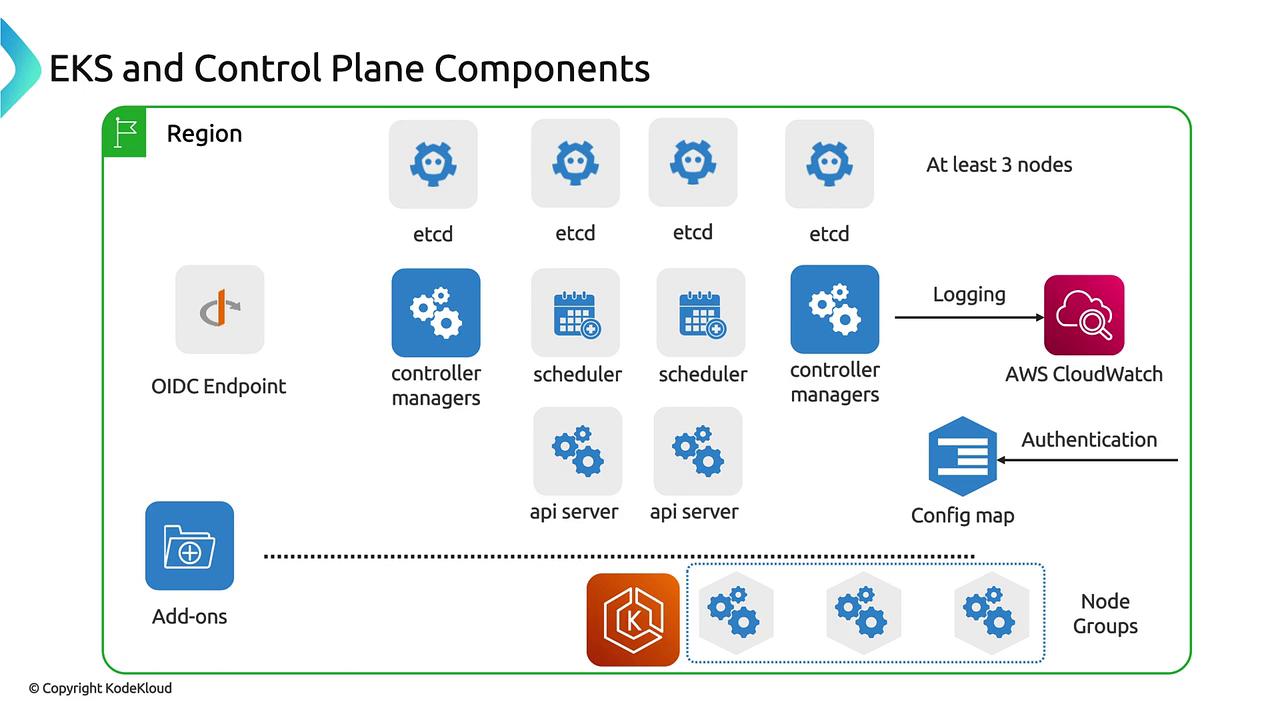
Amazon EKS is a regional service. Each cluster’s control plane is distributed across at least three Availability Zones (AZs) to guarantee high availability:
Automatic Failover: If one AZ becomes unavailable, etcd maintains quorum (read-only until a new leader is elected), and API servers route traffic through healthy AZs.
Cross-AZ Replication: AWS handles networking, latency optimization, and data replication between AZs without any additional configuration.
When deploying your own Kubernetes cluster, you’d need to configure multiple data centers, replicate etcd manually, and set up API servers, controllers, and schedulers across zones. EKS eliminates this operational overhead.
EKS extends the Kubernetes API with custom resources and services in your AWS account, handling your workloads and cluster add-ons:
Extension
Description
Node Groups
Managed or self-managed EC2 instances (Linux/Windows) where your pods run. Supports Auto Scaling groups.
Add-ons
Core cluster services (CoreDNS, kube-proxy, VPC CNI) deployed as pods. Managed via the EKS Add-on API.
These data plane components reside within your AWS account, giving you control over scaling, updates, and monitoring.
This diagram provides a holistic view of the Amazon EKS control plane services, AWS integrations, and data plane extensions that power a resilient Kubernetes cluster on AWS.