This article explores the Select Statement in Golang for managing channel operations and concurrency in Goroutines.
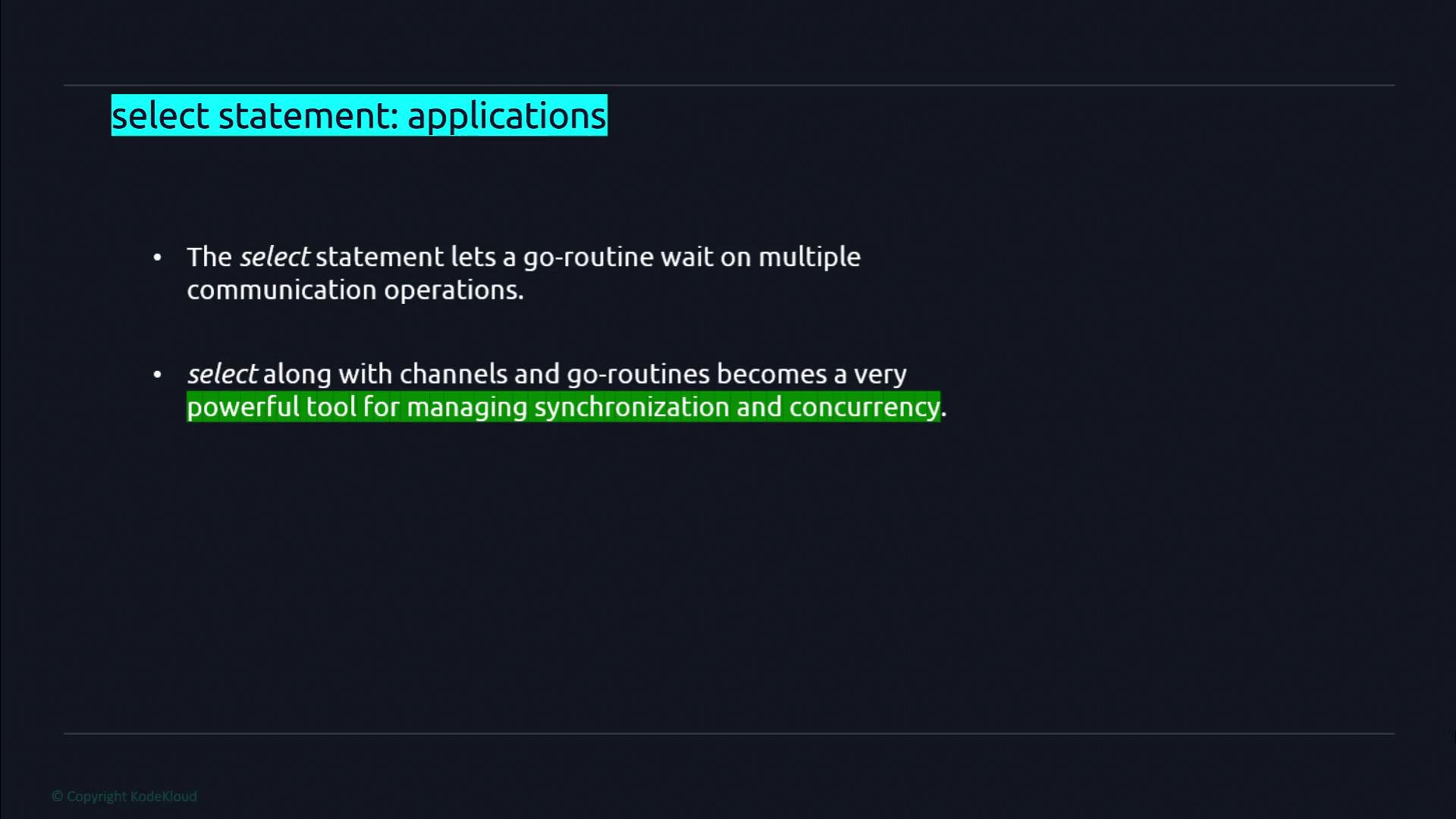
In this lesson, we will explore the Select Statement in Golang—a powerful construct specifically designed for channel operations. Unlike the conventional Switch statement, which evaluates expressions sequentially, the Select Statement enables a Goroutine to wait on multiple communication operations (SEND or RECEIVE) simultaneously.Two key characteristics of the Select Statement are:
It blocks execution until at least one of the case operations is ready.
If multiple operations are ready, one is selected at random.
The basic syntax of the Select Statement is as follows:
Copy
Ask AI
select { case channelSendOrReceive: // Do something case channelSendOrReceive: // Do something // Optional default case: default: // Execute if no other case is ready}
The Select Statement excels in concurrent programming when dealing with channels and Goroutines, offering a robust way to manage synchronization and concurrency.
Imagine a scenario where you need to fetch data from two servers simultaneously. By leveraging a Select Statement, you can initiate both calls concurrently. The first server to respond triggers its corresponding case to execute, making it an invaluable tool for handling asynchronous operations in Golang.
Let’s walk through a practical example. Initially, we create two channels, ch1 and ch2, which are designated to transfer string data. Then, two Goroutines are launched to send values to these channels.
Copy
Ask AI
package mainfunc main() { ch1 := make(chan string) ch2 := make(chan string) go goOne(ch1) go goTwo(ch2)}func goOne(ch1 chan string) { // Send a string value to ch1 ch1 <- "Channel-1"}func goTwo(ch2 chan string) { // Send a string value to ch2 ch2 <- "Channel-2"}
Next, we incorporate a Select Statement in the main function to receive values from these channels. Each case waits for data from its respective channel, executing the corresponding code once a value is received:
Copy
Ask AI
package mainimport "fmt"func main() { ch1 := make(chan string) ch2 := make(chan string) go goOne(ch1) go goTwo(ch2) select { case val1 := <-ch1: fmt.Println(val1) case val2 := <-ch2: fmt.Println(val2) } // Optional: wait for Goroutines to finish // time.Sleep(1 * time.Second)}func goOne(ch1 chan string) { ch1 <- "Channel-1"}func goTwo(ch2 chan string) { ch2 <- "Channel-2"}
When you run the program, you might see an output such as:
Copy
Ask AI
Channel-2
Keep in mind that the output is non-deterministic. If both channels have data ready at the same time, the Select Statement randomly chooses one, emphasizing the importance of designing your concurrent logic with this behavior in mind.
The Select Statement can include a default case to make it non-blocking. Without a default case, the select will block until one of the channel operations is ready. With the default case, the program can continue execution without waiting.For instance, consider this example without a default case:
In this scenario, if neither channel has a value when the select is evaluated, the default case executes immediately, allowing the program to proceed without delay.
Similar to the Switch statement, the break keyword can be used within a Select case to terminate its execution early. Consider the following example:
Copy
Ask AI
package mainimport ( "fmt" "time")func main() { ch1 := make(chan string) ch2 := make(chan string) go goOne(ch1) go goTwo(ch2) select { case val1 := <-ch1: fmt.Println(val1) break fmt.Println("After break") // This line will never be executed. case val2 := <-ch2: fmt.Println(val2) } time.Sleep(1 * time.Second)}func goOne(ch1 chan string) { ch1 <- "Channel-1"}func goTwo(ch2 chan string) { ch2 <- "Channel-2"}
In this example, once a value is printed from the selected channel, the break statement terminates that case, and the program immediately moves on to subsequent statements (here, the sleep function).
Remember that any code after the break statement within the same case will not be executed.
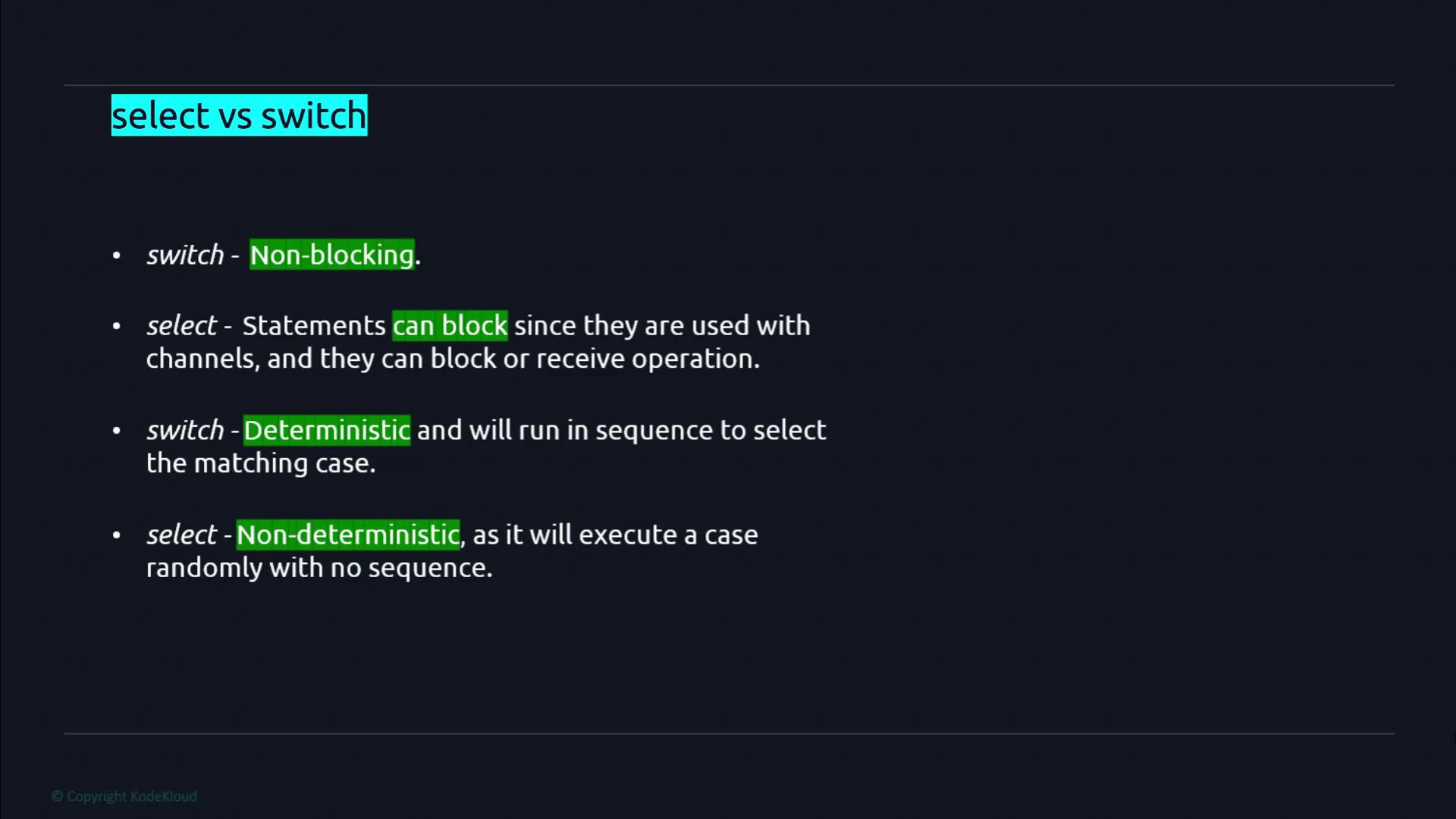
Understanding the differences between Select and Switch statements is crucial when designing concurrent programs in Golang. The table below highlights the main distinctions:
Statement Type
Blocking Behavior
Use Case
Characteristics
Switch
Non-blocking
Evaluating sequential expressions
Deterministic; executes the first matching case
Select
Blocks unless a default case is provided
Handling multiple channel communication
Can block; non-deterministic when multiple channels are ready
In summary, the Select Statement is an essential tool for Golang developers. It enables efficient management of multiple channel operations, ensuring smooth synchronization and concurrency within your applications.Happy coding!