The article traces OpenAIs journey from its 2015 origins, covering milestones, platform components, and generative AI services.
In this article, we’ll trace OpenAI’s journey from its 2015 origins through its major milestones and provide a high-level overview of the OpenAI platform—covering its foundation models, services, APIs, and developer tools.
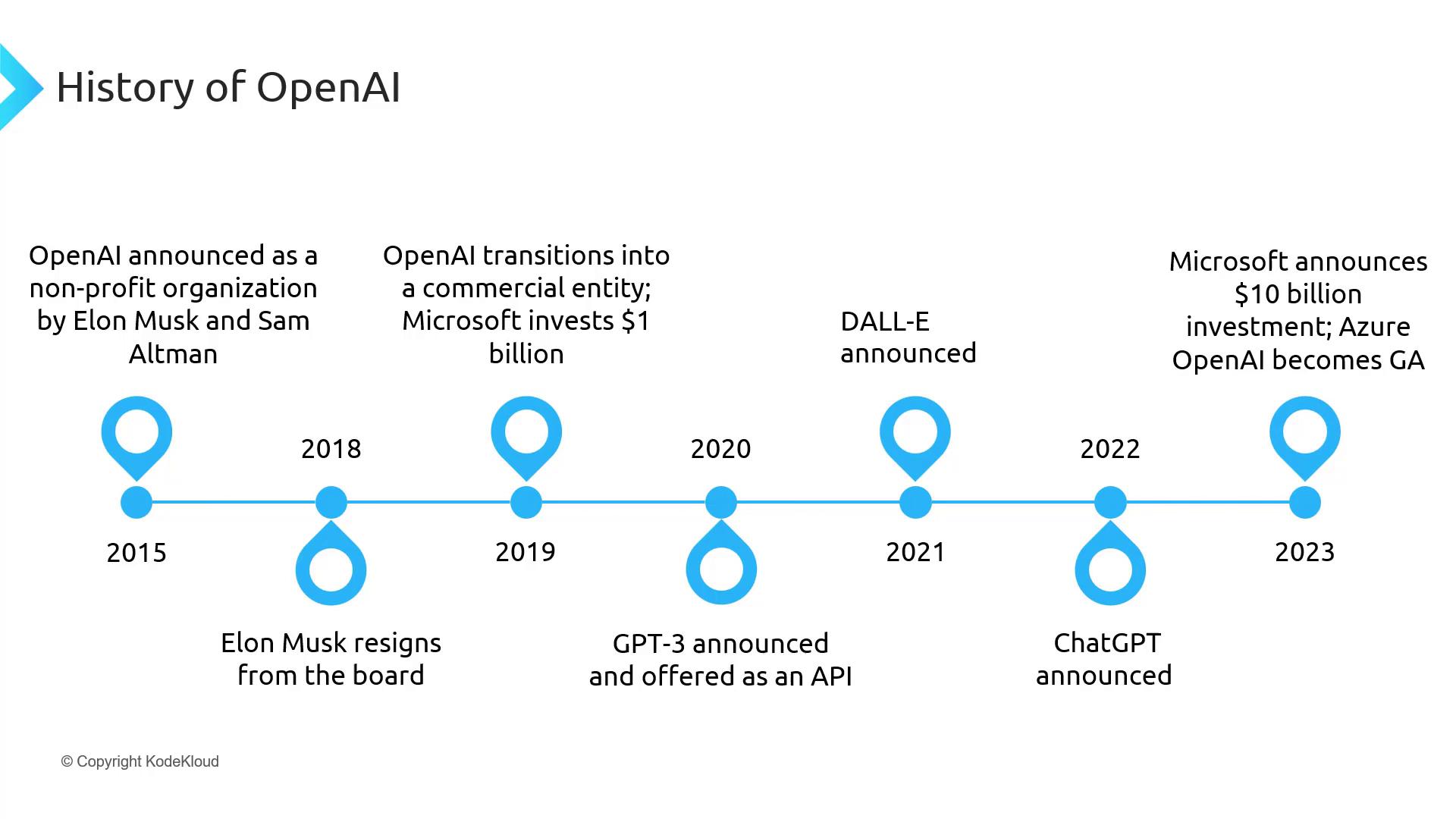
OpenAI began as a non-profit in December 2015 with a mission to ensure that artificial general intelligence (AGI) benefits all of humanity. Since then, it has evolved into a leading provider of generative AI services.
Year
Milestone
2015
Founded by Elon Musk, Sam Altman, Greg Brockman, and others as a non-profit AI research lab.
2018
Elon Musk resigned from the board, citing potential conflicts of interest.
2019
Converted to a “capped” for-profit entity and secured a $1 billion investment from Microsoft.
2020
Launched GPT-3, its first large-scale language model, accessible via a hosted API.
2021
Introduced DALL·E for text-to-image generation.
Late 2022
Released ChatGPT, a conversational AI powered by GPT series models.
Early 2023
Received an additional $10 billion commitment from Microsoft and expanded availability on Azure.
OpenAI’s shift from non-profit to for-profit aligned incentives for scaling infrastructure and delivering enterprise-grade AI services.
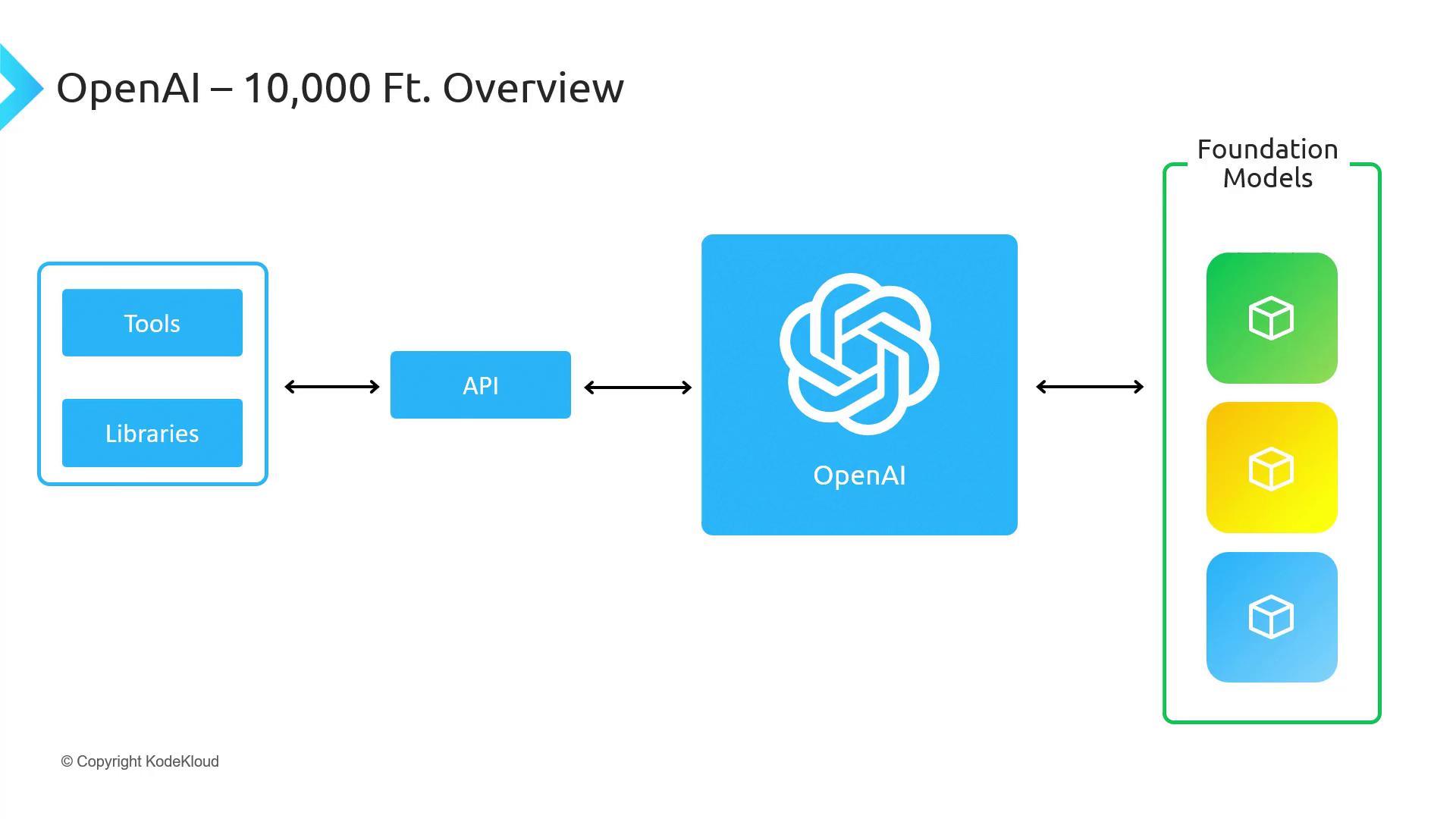
At its core, OpenAI provides generative AI as a service, enabling developers and organizations to integrate advanced models into applications. Below is a breakdown of the primary platform components:
Component
Purpose
Examples / Tools
Foundation Models
Pretrained, large-scale neural networks for language and vision tasks.
GPT-3, DALL·E, ChatGPT
Services Platform
Handles API orchestration, model versioning, user authentication, and security.
Rate limiting, billing, fine-tuning pipelines
API Layer
RESTful edge endpoints for easy integration into any environment.
POST /v1/completions, POST /v1/images/generations
Developer Tools
SDKs, CLI, and code samples for rapid prototyping and deployment.
OpenAI Python SDK, Node.js client, examples on GitHub
Applications can call the OpenAI API directly or use the official SDKs to streamline authentication, manage requests, and process responses in your preferred language.