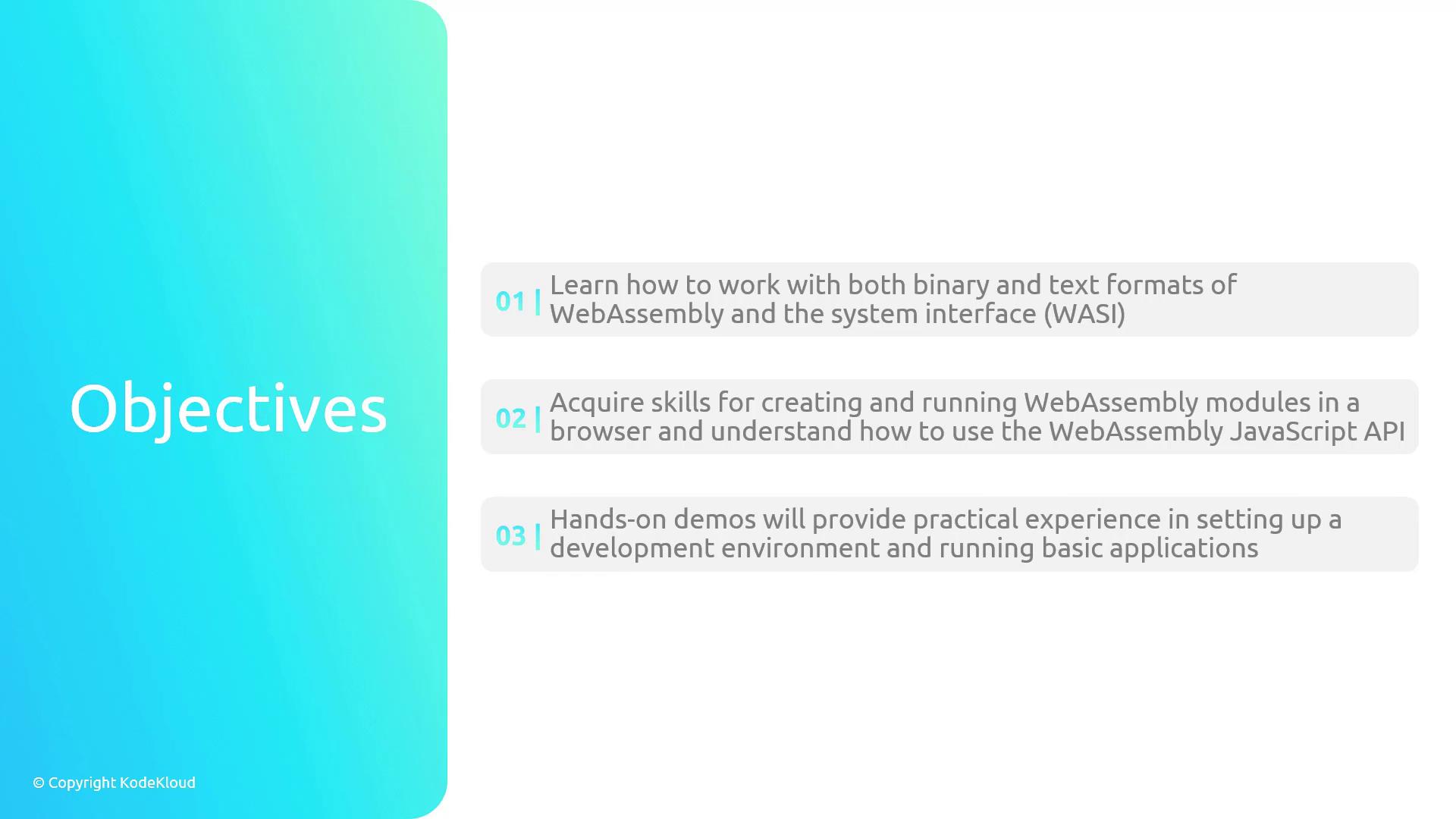
- WebAssembly Binary Format (WASM)
- Human-readable Text Format (WAT)
- WebAssembly System Interface (WASI)
Key Topics
| Topic | Description | Reference |
|---|---|---|
| WebAssembly Binary Format | Compact bytecode optimized for performance | WASM Spec |
| Text Format (WAT) | Readable s-expression syntax that assembles into WASM binary | MDN WAT Guide |
| WebAssembly System Interface | POSIX-like APIs for file I/O and networking in WASI environments | WASI Docs |
| Module Creation & Execution | Compiling from Rust/C/C++ to WASM and running modules locally | wasm-bindgen |
| JavaScript Integration | Loading and calling WASM functions via the WebAssembly JS API | MDN WebAssembly API |
Make sure you have:
- Node.js (v14 or later)
- Rust/C/C++ toolchain with WebAssembly targets
- A modern browser supporting WASM
- Differentiate between WASM binary and text formats
- Compile and run WebAssembly modules locally and in the browser
- Leverage WASI for system-level interactions
- Embed and interact with WebAssembly modules from JavaScript